
Book Your Free Consultation
Mr David Allamby
MD, FRCOphth, FRCS

Focus Clinics' proprietary A-LASIK procedure, developed by chief surgeon David Allamby, has resulted in a 100% success rate for all common myopia prescriptions and a boosted safety profile.
To be considered for A-LASIK surgery, you need to:
Be over the age of 18
Have a stable prescription over the past 12 months
Most people who have healthy eyes and have short-sight (with or without astigmatism) are good candidates for LASIK eye surgery, except for extreme prescriptions.
Mild to moderate degrees of long-sightedness can also usually be treated, and we can also treat many patients who need glasses for reading with our LASIK Blended Vision procedure.
Our LASIK eligibility guide provides more details on whether you'd be a suitable candidate for LASIK surgery.
We can give you a good idea of your suitability for LASIK surgery over the phone and schedule you for your initial consultation. Submit your details below, pick a time that works best for you and a member of our team will be in touch to discuss your options.
At Focus Clinics, our team has over 70 years of combined industry experience and has completed over 60,000 successful surgeries.
Want to see real reactions from real people, just moments after they've had LASIK surgery?
Focus has a 100% 20/20 vision success rate for all common short-sighted prescriptions using it’s A-LASIK technique
...is considered pain-free by most patients
...is performed as a day-case with the whole visit lasting 2 hours
...treatment completed within 10 minutes for both eyes
...gives excellent vision in 4 hours for most patients
LASIK eye surgery ('laser-assisted in-situ keratomileusis') is the most widely performed laser eye surgery in London to correct short-sight, long-sight, astigmatism and presbyopia (the need for reading glasses).
At Focus, your surgeon will perform more than 150 steps on each eye with our advanced LASIK procedure (A-LASIK), developed by chief surgeon David Allamby. A-LASIK has resulted in a 100% success rate for all common myopia prescriptions and a boosted safety profile. For LASIK in general, ninety percent of the treatment is done manually by the surgeon, with the lasers active for only 10% of the duration. Hence, getting an expert surgeon is very important.

Anaesthetic eye drops are applied to fully numb the surface of your eye to ensure there is no pain during the procedure. If you are very nervous, we can provide a tablet to help you relax, though most patients manage perfectly well without the need for a sedative.

Your skin on the face and around the eyes is cleaned and you will have a paper hat to keep your hair away. You will lie down on the laser bed and positioned so that you can see a small blinking green light.
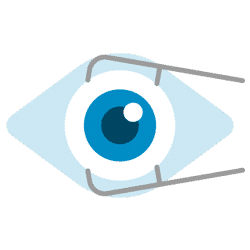
A small speculum will be used to keep your eye open. While it is in place, you cannot feel it and you can blink as normal. It will feel exactly as if you are blinking, even though the eye does not close. There is no need to try to keep your eyes open.

Your surgeon uses the first Ziemer LDV femtosecond laser to create a corneal flap. You will feel a sense of pressure for about 25 seconds. This is an extremely precise laser that uses a finer pulse for better healing.
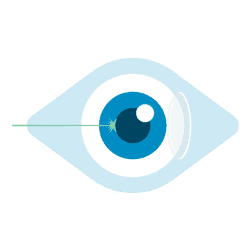
Your prescription will already have been programmed into the second WaveLight ‘excimer’ laser. After the flap has been gently folded to the side, the excimer laser will correct your vision usually in just 5-10 seconds. You simply need to look at the green light.

The laser treatment itself takes 5-10 second and is painless.
LASIK is performed on each eye separately, usually on the right eye first followed by the left eye. Each eye is completed in 4-5 minutes.
Speak to the team
We can give you a good idea of your suitability over the phone and schedule you for an initial consultation.
The LASIK procedure generally takes no longer than 10 minutes for both eyes and recovery begins as soon as the procedure is over.
Most patients will notice an improvement in vision as soon as the surgery is over, and the final results should settle within 2 to 3 months, depending on the prescription.
Your eyes will feel watery, gritty and/or heavy for around 3-4 hours after your procedure. Anaesthetic drops are supplied in your take-home pack, which you may want to use once or twice.
Most people who have healthy eyes and have short-sight with or without astigmatism are good candidates for LASIK eye surgery, except for extreme prescriptions. Mild to moderate degrees of long-sightedness can also usually be treated. We can also treat many patients who need glasses for reading with our LASIK Blended Vision procedure.

LASIK may also be combined with Blended Vision to treat the need for reading glasses.
Most clinics charge £2000 to £2500 per eye for laser eye surgery, so expect to pay between £4-5000 for the complete treatment.
Prices advertising exceedingly low prices, e.g. “From £595...” are not usually genuine, limited to tiny prescriptions and using an older technology. Many of our patients who enquired at other centres found that even clinics advertising very low prices often charge more than £4,000 when modern technology is used for typical prescriptions.
Remember that LASIK is not a commodity; it is precision microsurgery on your eyes.
You are not buying LASIK surgery on its own but rather a complete treatment package. This must include a comprehensive assessment, meeting your surgeon on a day before your eye surgery is to happen (some clinics only do a phone call), and long-lasting aftercare.
At Focus, we include a 10-Year Guarantee for free re-treatment (should it be needed and available for our short-sighted treatment patients) during the first decade after your surgery. Most clinics only include 12 months of free re-treatment.
We also include our Lifetime Aftercare, where if you think your treatment is wearing off, you can return any time without charge, even many years later. Many clinics will charge you for attending after the initial period.
Your LASIK fee is for a package of care so make sure you compare like-for-like when looking at laser treatment providers. Just comparing the quoted surgery price may leave you paying more later on.The effects of laser vision correction are generally permanent, but in a small percentage of cases, retreatment or enhancement may be required. The number of patients who were originally treated for short-sightedness and who have returned to us for a boost is around 1% over the years.
At Focus Clinic, we offer a 10-year free re-treatment guarantee, which means that if you do require an enhancement up to 10 years later, we will provide this completely free of charge. This is for patients who were short-sighted, with or without astigmatism.
Most clinics only offer 12 months of re-treatment without incurring further fees, which can be as much as the original amount paid.
Please note that long-sighted prescriptions, including the need for reading glasses, are age-related. Hence they will progress as the patient gets older. These treatments are not included in the 10-year guarantee but will get our Focus Lifetime Aftercare, where they can return at any time for an opinion and assessment if the treatment appears to be waning (which it will as the years go by).
Refractive surgery has been around for more than 30 years and is now a very evolved procedure with consistent and excellent results.
How laser eye surgery works to correct the focus of your eyes is well-understood. Indeed, the principles have been applied to the cornea with alternative surgical approaches since the 1930s. The excimer laser will reshape the curvature across your cornea and move the point where light comes into focus at the back of your eye.
For short-sightedness (the most common laser eye treatment), where the image is incorrectly focused in front of the retina, the cornea must be made slightly less curved, i.e. flatter. This flattening moves the point where rays of light converge backwards so that it now happens at the level of the retina. The focused light is detected by the retina, resulting in you seeing something as a clear, sharp image.
To make this a permanent effect, the laser needs to remove tissue from the central collagen area, known as the stroma. This is achieved by creating a thin superficial flap using a femtosecond laser in the LASIK procedure or removing the top layer of skin cells in PRK or LASEK surgery.
For the past 3 years, 100% of Focus patients with typical short-sighted (myopic) prescriptions have achieved 20/20 vision with a single treatment. We do not know of any other clinic that has achieved this success rate.
We published our results in a peer-reviewed scientific journal, and you can see the research paper here.
Our commitment to a 100% success rate for 20/20 and better has taken us to new levels of excellence in clinical outcomes. And while this does not guarantee your individual success, our results from the past 3 years will give you a high degree of confidence that you will attain a very clear level of unaided vision.
Our commitment to you is that we will not perform treatment on you or anyone we feel does not have an excellent possibility of achieving independence from glasses and contacts. Our team is risk-averse, meaning that we do not take chances ourselves or take them on your behalf.
The vast majority of our patients are extremely happy with their results and can do most activities without dependence on corrective lenses after vision correction. For typical short sight, 99.7% of patients can see better than 20/20 following their laser vision correction.
See here for more about our results.Not sure who offers the best laser eye surgery in London?
You should look at the total package for your vision correction. LASIK laser eye surgery is not a commodity but rather precision microsurgery on your eyes. Pay what it costs to get a premium provider - because it’s your eyes.
Look at what the aftercare includes. Is there a free re-treatment period? Can you return later without being charged?
(We offer a unique 10-year free re-treatment guarantee for our short-sighted laser procedures. Most clinics offer just 12 months and then will charge you again.)
You should look for excellent reviews and an extremely high proportion of 5-star ratings. The most common review sites in the UK are Trustpilot and Google.
You can click here to see how Focus Clinic compares with the UK’s eye care clinics on Trustpilot.
Choosing the right surgeon to perform your laser eye surgery is also a key part of your choice. It can be a difficult decision and one that you should not base solely on price. Often, those clinics that charge lower prices have to turn over a large number of patients, meaning that the care you get could be substandard.
Again, follow the reviews and see how actual patients rated their clinic and their surgeon.
Laser eye surgery procedures are extremely safe when performed on patients who are good candidates for vision correction.
It has been around now for more than 30 years and has evolved into a stable and safe procedure. In fact, it is one of the safest surgical procedures in the world.
As with any surgical procedure, there will always be a degree of risk, but this is very minimal.
To make sure you are suitable, any clinic should follow an extensive suitability screening process. At Focus, we conduct what we believe to be the most in-depth assessment possible.
Not everyone is suitable for laser eye surgery. However, in well-selected candidates, it is a highly safe and predictable procedure performed more than 50 million times across the world.
People who may not be suitable for laser eye surgery may be people over the age of 65 or younger than 18, those with a pre-existing eye disease or immune disorder, or those people with very high refractive errors.
If you've been wearing glasses or contact lenses with a stable prescription for the last 12 months, and you don't suffer from a pre-existing eye disease, you could be a suitable candidate.
The easiest way to confirm your suitability is to schedule a free telephone consultation.
On your treatment day, expect to be with us for around two hours. However, the surgery itself only takes around 10 minutes for both eyes!
Why will you be there for two hours then? The rest of the time is used to ensure the safest possible treatment for you and your eyes.
Your eyes will be re-scanned, so we have the latest data. You will meet your surgeon again to confirm the health of your eyes and re-measure your prescription (especially important if you have been using contact lenses previously).
The scans will assess thousands of data points with remarkable accuracy. We only use the latest scanners, such as the Osiris-T wavefront aberrometer with a resolution of 45,000 points, higher than any other device.
The goal: 100% accuracy for your surgery.
Afterwards, you will spend 10-20 minutes in our patient recovery room or lounge, where you can relax, drink tea and eat biscuits while your eyes adjust after surgery.
Most patients will have better vision straight after LASIK surgery and excellent 20/20 vision or better just 4-24 hours later. With other laser procedures, it will take longer to get great vision: lenticule extraction (e.g. CLEAR, SMILE) takes 1-7 days to recover, and PRK/LASEK takes 4-10 days.
The end results of each type of procedure are very similar, but LASIK offers the fastest recovery.
* 100% 20/20 success is from our peer-reviewed published results for LASIK binocular vision treating short-sight up to -6.00 dioptres including up to 2.00 dioptres of astigmatism.
**J Cataract Refract Surg. 2023 Nov 1;49(11):1140-1146. Ray-tracing-guided myopic LASIK: real-world clinical outcomes. George He, Chandra Bala

100% SUCCESS RATE
10 YEAR GUARANTEE
#1 IN THE UK TRUSTPILOT RATING
CELEBRITIES CLINIC OF CHOICE

Registered in England 4585464
Focus Clinic © 2025