
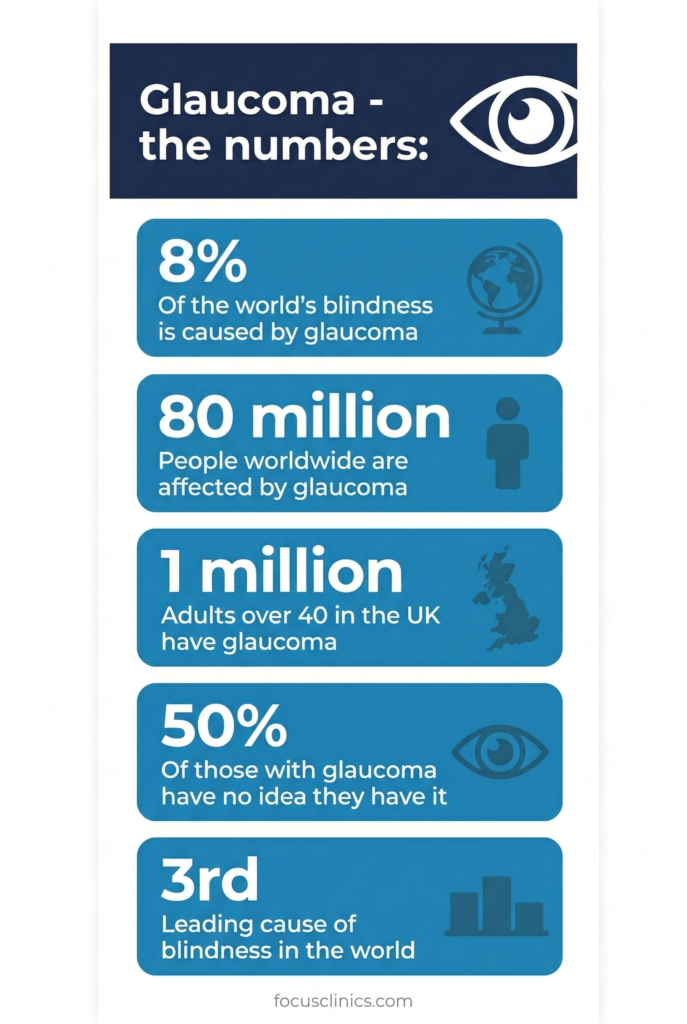
By 2040, it’s estimated that 22 million people across the world will have gone blind from glaucoma. 80 million people are already living with it, with no symptoms until it’s too late to save their eyesight.
This World Glaucoma Week, we’re raising awareness of this condition. We’re going to explain what it is and how you can protect yourself from glaucoma below, but first, here are the figures.
What is Glaucoma?
Glaucoma gradually damages the optic nerve, most commonly through a gradual build-up of pressure inside the eye. The pressure builds up so slowly that it’s unnoticeable yet causes damage to the optic nerve, which is the nerve that connects your eyes to the brain. Once that nerve is damaged, it doesn’t heal.
“What makes this particularly cruel is that glaucoma typically begins at the edges of your vision, your peripheral vision. Here, your brain is extraordinarily good at filling in the gaps. You adapt, without realising you’re adapting. By the time central vision is affected and you genuinely notice something is wrong, the disease is often already quite advanced.”
There is currently no cure for glaucoma, and any vision already lost cannot be recovered. But caught early, progression can be slowed or stopped entirely with the right treatment. That’s why early detection is everything.
Why Doesn’t Anyone Talk About It?
Glaucoma doesn’t have the cultural profile of conditions like macular degeneration or cataracts. And because it progresses so quietly, it rarely generates the dramatic “I suddenly lost my sight” story that tends to capture public attention.
But mostly, I think, it goes unspoken because nearly half of all cases remain completely undiagnosed. That’s 40 million people worldwide living with a condition they don’t know they have. You can’t talk about something you’re unaware of.
Recent projections suggest that by 2040, 111 million people will have glaucoma. Between 15% and 20% of those people risk losing their sight entirely if awareness doesn’t improve and if more people don’t know how to get checked.
What makes this particularly alarming is how simple getting checked actually is. Which brings me to the most important question about glaucoma: when did you last have a proper eye test?
How to Get Tested for Glaucoma
I think some people avoid eye tests because they’re not sure what to expect or they assume it’ll involve something uncomfortable.
However, a comprehensive eye examination for glaucoma typically involves just three things:
- Measuring the pressure inside the eye
- Examining the optic nerve, either directly or through detailed imaging technology like OCT scanning
- Testing your peripheral vision.
The whole process is straightforward, painless, and can be done at your local optician.
In the UK, NHS-funded sight tests are available free of charge to anyone over 60, anyone with a family history of glaucoma aged 40 or over, and a number of other at-risk groups. There is genuinely no barrier to getting checked.
“The test is quick. It’s painless. And it could be the thing that saves your sight.”
Who Should Be Most Alert?
While glaucoma can affect anyone, there are groups I’d particularly urge to act, and to act now, not when they get around to it.
- Anyone over 40, especially if they haven’t had an eye test in the past two years
- Anyone with a parent or sibling who has been diagnosed with glaucoma, your risk is up to ten times the average
- People of African, Afro-Caribbean, or East Asian descent face a significantly higher risk
- Anyone with diabetes, high blood pressure, or significant short-sightedness
- Anyone who has been on long-term steroid medication
If any of those apply to you, please don’t file this away as something to think about later.
Get tested, get treated.
What Happens If You Are Diagnosed
For the majority of patients, glaucoma is a manageable, chronic condition. It’s not a death sentence for your vision. Treatment usually begins with prescription eye drops to lower the pressure inside the eye, and many people manage the condition successfully with drops alone for many years. Laser treatment and surgery are also available in the UK for more advanced cases or where drops aren’t sufficient.
Most people with glaucoma continue to drive, work, and live completely normal lives. The condition doesn’t have to define you. What defines the outcome, more than anything, is how early it’s found.
Raise awareness this World Glaucoma Week
Every year, World Glaucoma Week gives the eye health community an opportunity to say, loudly and clearly: this condition exists, it is common, it is serious, and it is largely preventable, if caught in time.
“I’ve been an eye surgeon for over thirty years. I’ve seen what glaucoma does when it goes undetected. This is why this week is so important. It increases awareness of this silent disease and limits its impact across the world.”
The theme of this year’s World Glaucoma Week is “Uniting for a Glaucoma-Free World.” I believe that world is achievable. But it starts with one simple thing: more people knowing this condition exists and getting their eyes tested.
If you’re reading this and you haven’t had an eye test recently, please book one.
It might be the most important appointment you make this year.
