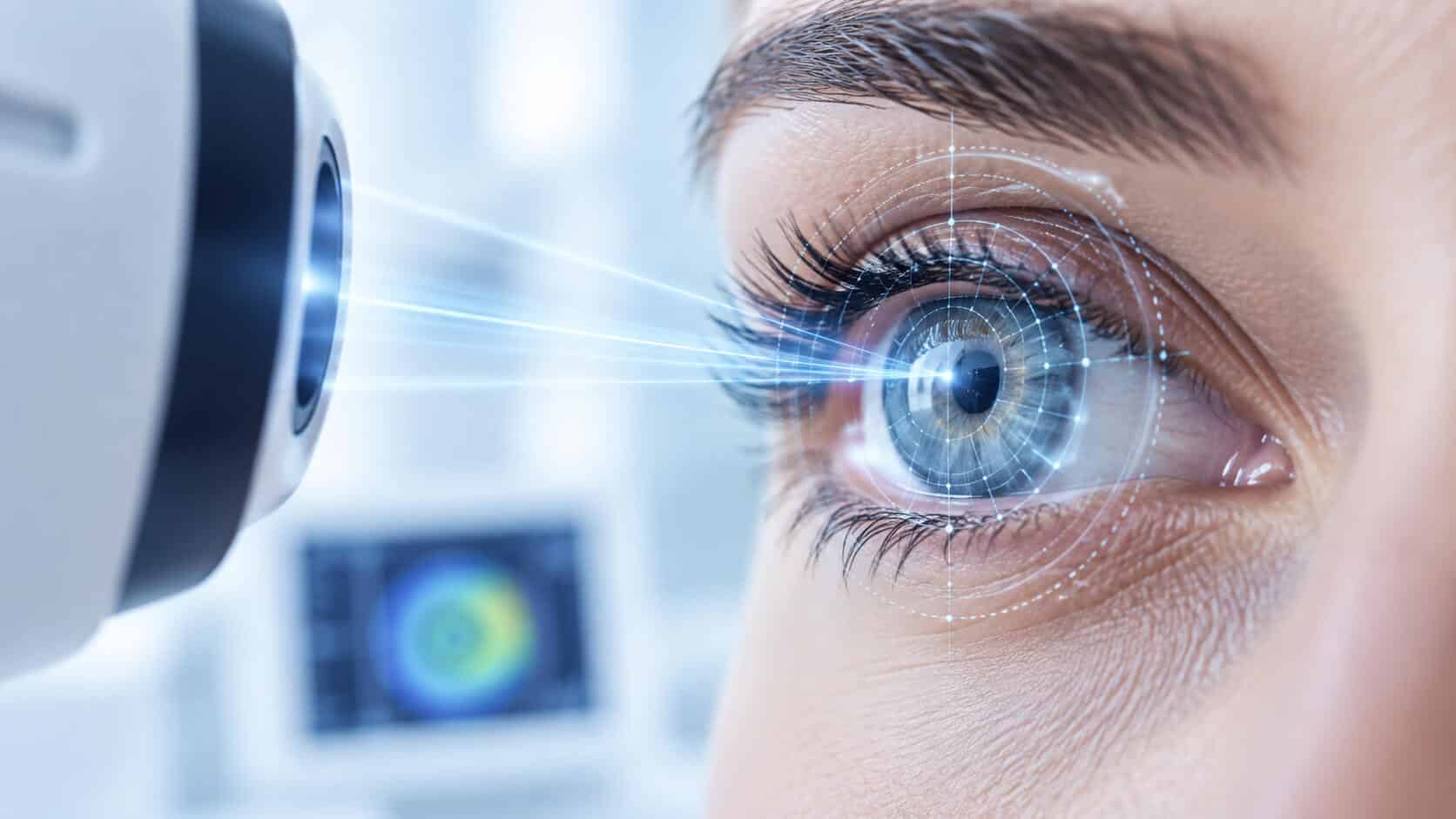
Ray-tracing-guided LASIK is still much less familiar than standard LASIK, mainly because it is newer, available at relatively few clinics and depends on a specific diagnostic and treatment setup. Public awareness has simply not caught up with the technology yet.
Why is ray-tracing-guided LASIK not widely known?
✓ It is much newer than conventional LASIK
✓ Relatively few clinics currently offer it
✓ It requires specific diagnostic and laser technology
✓ Patients may encounter the WaveLight Plus name instead
✓ New refractive technologies usually reach clinics before they become familiar to the public
A Newer Step in the Evolution of LASIK
LASIK has been performed for decades, so the name itself is familiar even to people who know very little about laser eye surgery.
The technology used to plan LASIK has continued to develop during that time. More than a decade ago, topography-guided LASIK was regarded as one of the newer advances in refractive surgery. Today, ray-tracing-guided LASIK is a more recent option for surgeons.
The initial concept paper for using ray tracing with a whole-eye model was published back in 2008. [1] An initial group of patients was treated within a few years using an earlier version of the technology, with impressive results. [2]
Established treatments have years of patient experience, clinic marketing and word of mouth behind them. A newer method can be well known among refractive surgeons long before people researching laser eye surgery for the first time know its name.
Focus Clinics introduced ray-tracing-guided LASIK in the UK in 2024.
There are now multiple studies showing how effective ray-tracing-guided LASIK can be. [3, 4] A 2026 meta-analysis of published research showed 99.2% of patients achieving 20/20 vision or better. [6] This is significantly better than current technology, with around 90% of patients achieving 20/20. [7]
Very Few Clinics Currently Offer It
One of the simplest reasons ray-tracing LASIK is not widely known is that relatively few patients currently come across it.
Focus Clinics was the first UK clinic to introduce the technology and is currently the only UK clinic offering ray-tracing-guided LASIK.
However, as of late 2026, about 400 hospitals and clinics worldwide offer ray-tracing-guided treatment, mainly in the US and China.
Focus Clinics is currently the only UK provider offering ray-tracing-guided LASIK and PRK.
When only a small number of clinics offer a treatment, there are naturally fewer websites discussing it, fewer patients talking about having had it, and fewer opportunities for someone casually researching LASIK to encounter the term.
That can make a treatment seem more unusual than it actually is within the wider refractive-surgery field.
It Requires Specific Technology
Ray-tracing-guided LASIK is not simply another treatment option that can be switched on within every existing LASIK setup.
The WaveLight Plus system uses the SightMap diagnostic device to collect detailed measurements of the eye, including ocular wavefront, biometry and corneal tomography. These measurements are used to create a three-dimensional model of the individual eye and calculate a personalised treatment profile.
Each eye model requires 140,000 separate data points to build.
The treatment also requires the latest WaveLight excimer laser, of which there are very few in the UK, despite it being the world’s most popular laser.
Adopting the treatment therefore requires the relevant diagnostic and laser technology, as well as the clinical training needed to use it.
That helps explain why adoption is more gradual than it might be for a simple software update or variation of an existing procedure.
A Surgeon’s Perspective
For almost three decades, we have known that customising LASIK surgery to a patient’s unique eye can provide better outcomes than an off-the-shelf treatment plan.
We also know that conventional LASIK, PRK and SMILE can worsen an eye’s internal optics compared with pre-operative levels. This can result in poorer night vision, including halos, glare, ghosting and starbursts. A patient may achieve 20/20 vision, but clarity and crispness, especially at night, can remain poor.
Various attempts to customise a treatment to a patient’s eye have been tested and approved, including wavefront-guided and topography-guided ablation profiles.
Wavefront-guided surgery showed little or no benefit over conventional wavefront-optimised treatment. Topography-guided treatment, which modifies treatment based on the shape of the cornea, did improve results and was approved by the FDA in 2015 as Contoura (from manufacturer WaveLight in Germany).
I first heard about ray-tracing-guided treatment in 2007, after discussions with WaveLight. The science was very exciting. It could finally provide a customised treatment tailored to the whole eye. I had to wait nearly 20 years for the technology to become available in the UK.
After over a thousand treatments during the past two years, I can confidently say it has surpassed my expectations. In addition to achieving a 100% success rate for 20/20 vision across all common prescriptions, we also see no significant worsening of internal optical aberrations.
More than half of eyes attain 20/12 visual acuity, two lines below 20/20 on the chart, which provides very high visual clarity.
Night vision problems have been one of the biggest complaints about laser eye surgery over the past decades. Here, ray tracing has been a game changer. Even for high-risk patients, we have seen no night vision issues, such as halos, glare or starbursts. In fact, many patients describe their night vision as better than it was pre-operatively.
— Mr David Allamby MD, FRCOphth
Clinics Usually Talk About the Treatments They Offer
Most people first learn about the different forms of laser eye surgery through clinic websites, consultations, advertising or recommendations from previous patients.
Clinics naturally spend most of their time explaining the procedures and technologies they already offer. As a result, patients are far more likely to have encountered familiar terms such as LASIK, SMILE, wavefront-guided LASIK or topography-guided treatment.
When only a few clinics offer a newer technology, it has far fewer routes into everyday patient awareness.
That does not make one approach automatically better than another. Different treatments remain appropriate for different eyes.
The Terminology Can Make It Harder to Recognise
There is also a naming issue.
Ray-tracing-guided LASIK describes the treatment-planning approach. WaveLight Plus is Alcon’s commercial platform that uses ray-tracing technology to create a personalised LASIK treatment plan.
Patients may therefore see the phrase WaveLight Plus LASIK in one place and ray-tracing-guided LASIK elsewhere without immediately realising the two are closely connected.
They may also encounter SightMap, which is the diagnostic system used to collect the measurements needed to build the personalised eye model. It is part of the treatment process, not another type of LASIK.
The terminology is familiar in the refractive surgery world, but it may not be intuitive for someone encountering it for the first time.
Refractive Surgery Technology Has Evolved in Stages
Ray tracing is better viewed as part of the continuing development of personalised refractive surgery rather than as a completely separate form of laser eye surgery.
Earlier generations of treatment planning included wavefront-guided and topography-guided approaches. Topography-guided LASIK, for example, uses detailed information about the shape of the corneal surface to help plan treatment.
Ray-tracing-guided planning draws on a wider set of measurements to create a three-dimensional optical model of the individual eye. It is the only treatment that uses a whole-eye model to customise laser treatment.
Importantly, newer does not mean that older approaches suddenly become obsolete. Some patients may be suitable for other treatments, with the choice of procedure remaining a clinical decision.
Less Well-Known Does Not Mean Experimental
Low public awareness can sometimes make a treatment sound experimental. That is not an accurate way to describe ray-tracing-guided LASIK.
The clinical development of optical ray tracing in refractive surgery is not new. Published research on ray-tracing treatment planning dates back to 2008, with clinical LASIK studies following in 2012. Published clinical research now includes real-world studies, international multicentre research and prospective trials.
More recently, ray-tracing-guided LASIK has been included in comparative refractive-surgery research and in updated professional ophthalmology teaching materials. [5]
Key Takeaway
Ray-tracing-guided LASIK is less familiar largely because it is newer, less widely available and dependent on specific technology. Its relatively low public profile reflects how recently it entered wider clinical use, rather than a lack of research.
What This Means if You’re Considering Ray-Tracing LASIK
If you are comparing laser eye surgery options, the name of the procedure is only part of the picture. Useful questions to ask include:
- What technology do you recommend for my eyes?
- How will my treatment plan be created?
- Why is this approach being recommended instead of another option?
- Who will review and approve my treatment plan?
References
- Mrochen M, Bueeler M, Donitzky C, Seiler T. Optical ray tracing for the calculation of optimized corneal ablation profiles in refractive treatment planning. Journal of Refractive Surgery. 2008;24(4):S446–S451. PubMed
- Schumacher S, Seiler T, Cummings A, Maus M, Mrochen M. Optical ray tracing-guided laser in situ keratomileusis for moderate to high myopic astigmatism. Journal of Cataract & Refractive Surgery. 2012;38(1):28–34. PubMed
- Beers A. What Does Ray Tracing-Guided LASIK Have in Store? Review of Ophthalmology. 11 February 2026. Review of Ophthalmology
- American Academy of Ophthalmology. Latest Evolution of LASIK Technology Shows Superior Results in New Study. 18 October 2025. American Academy of Ophthalmology
- Molleti S, Pawlowski H, Uyeda RM, et al. Initial Visual and Refractive Outcomes of Ray-Tracing-Guided LASIK (WaveLight Plus) Versus KLEx (SMILE Pro). Ophthalmol Ther. 2026;15:3401–3419. doi:10.1007/s40123-026-01475-1
- Friedrich M, Augustin VA, Auffarth GU, et al. Visual Outcomes and Safety of Ray-Tracing-Guided Laser-Assisted In Situ Keratomileusis: A Systematic Review and Meta-Analysis. Ophthalmol Ther. 2026;15:1623–1645. doi:10.1007/s40123-026-01376-3
- Susanna BN, Mohan N, Santhiago MR, Randleman JB. Laser in situ keratomileusis outcomes and complications: 2016 to 2023. J Refract Surg. 2025;41(4):e391–e403. doi:10.3928/1081597X-20250312-01