
Book Your FREE Telephone Consultation
Mr David Allamby
MD, FRCOphth, FRCS

QUICK ANSWER
Choose the lens around the life you actually lead. If you want the simplest optics and are happy to use reading glasses, start with a monofocal. If computer distance matters, ask about an enhanced monofocal or extended depth of focus (EDOF) lens. If reading without glasses is the priority, discuss a trifocal and its potential for halos (Cho et al., 2022 [2]; Tavassoli et al., 2024 [9]). Toric is a separate decision: it corrects astigmatism and can be combined with a monofocal, EDOF or trifocal lens. Your eye health, especially the cornea and retina, can narrow the options before lifestyle enters the conversation (Al-Mohtaseb et al., 2024 [1]; McNeely et al., 2025 [6]).
We can give you a good idea of your suitability over the phone and schedule you for an initial consultation.
DIRECT ANSWER
A monofocal lens targets one distance. Enhanced monofocals, EDOF lenses and trifocals add or spread useful focus in different ways. A toric version corrects astigmatism alongside the focus choice.
An intraocular lens, or IOL, replaces your natural lens during cataract surgery or refractive lens exchange (RLE). The operation is similar in both cases; the reason for it differs. In cataract surgery, the natural lens has become cloudy. In RLE, it may still be clear, but is replaced to correct vision. The Royal College of Ophthalmologists describes these distinctions and the alternatives to RLE (RCOphth, 2024 [13]).
Lens design | Usually strongest at | Likely glasses need | Main discussion |
|---|---|---|---|
Standard monofocal | One chosen distance, often far | Often needed for reading and some middle-distance tasks | Where to set the focus |
Enhanced monofocal | Far, with a modest middle-distance gain | Usually needed for small print | How much intermediate vision the exact model adds |
EDOF | Far through intermediate | May still be needed for close reading | Near vision and night-time effects of the exact design |
Trifocal | Far, intermediate and near | Less likely, but still possible | Halos, glare and contrast in dim light |
Toric option | Correcting regular corneal astigmatism | Depends on the focus design it is paired with | Corneal measurements and lens alignment |
These are broad patterns, not individual predictions. Evidence comparing lens categories comes from Cho et al., 2022 [2], Tavassoli et al., 2024 [9] and Verstraaten et al., 2026 [11].
KEY TAKEAWAY
Start with the distance that matters most to you. Then decide how much you value freedom from glasses, and what visual side effects you would accept to get it.
KEY DATA POINT
In a network meta-analysis of 27 randomised trials involving 2,605 people, the main lens classes had comparable unaided distance vision, while trifocals gave better unaided near vision than monofocals (Cho et al., 2022 [2]).
KEY TAKEAWAY
If you are comfortable putting on reading glasses, do not feel pushed towards a multifocal lens.
DIRECT ANSWER
A monofocal lens targets one distance. Enhanced monofocals, EDOF lenses and trifocals add or spread useful focus in different ways. A toric version corrects astigmatism alongside the focus choice.
Monofocal does not mean one-size-fits-all. We can discuss setting the lens for distance or near vision. Some patients prefer one eye aimed a little nearer than the other, called monovision. That changes depth perception and comfort for some people, so it deserves a proper trial or a frank discussion rather than an automatic choice.
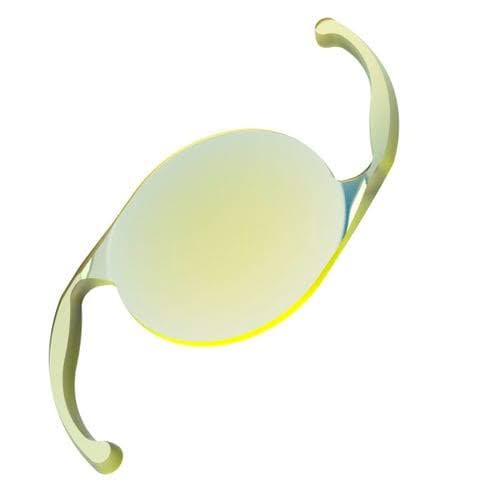
Examples of monofocal lenses include the Alcon Clareon and the TECNIS Monofocal.
NICE recommends NHS monovision after cataract surgery for people already used to anisometropia or monovision who want to keep it (NICE NG77, recommendation 1.4.3 [12]).
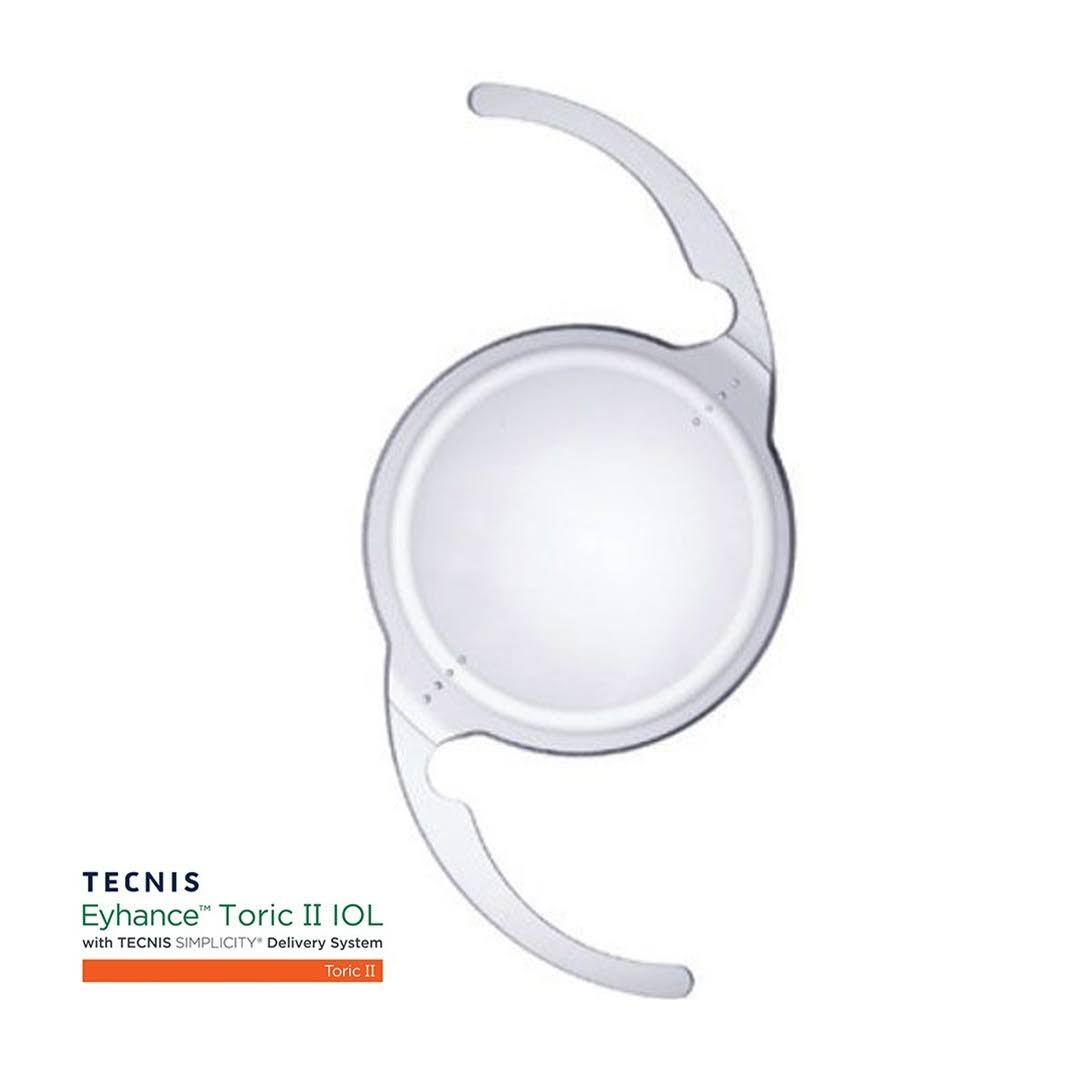
Tecnis Eyhance Enhanced Monofocal Lens
KEY DATA POINT
Across six randomised trials and 429 patients, enhanced monofocals improved binocular unaided intermediate vision by a mean 0.10 logMAR (one line on the test chart) compared with standard monofocals (Loh et al., 2026 [5]).
KEY TAKEAWAY
Ask to test the distance of your own screen, not an abstract promise of "better middle vision".
DIRECT ANSWER
It gives a modest extra range around intermediate distance, useful for some computer and kitchen tasks. It is not a reading-glasses-free lens.
Enhanced monofocal is sometimes called monofocal plus. TECNIS Eyhance is one studied example; other designs are available. It aims to stretch the depth of focus without creating the three distinct focus points of a trifocal.
Tecnis Eyhance Enhanced Monofocal Lens
The improvement sounds small on paper, but for someone who spends much of the day at arm's length, it may be useful.
A 2026 review of randomised trials found better intermediate acuity than with standard monofocals, with no broad significant difference across other measured secondary outcomes (Loh et al., 2026 [5]).
Some research summaries describe EDOF as generally causing fewer halos than trifocals. That is too strong as a class-wide claim. The 2024 Cochrane review compared trifocals with one older EDOF model, Symfony, and its glare and halo studies were too small to establish a meaningful difference (Tavassoli et al., 2024 [9]). A Vivity registry subgroup using mini-monovision reported few disturbances, but it was observational and does not prove that every EDOF lens beats every trifocal (Teus et al., 2025 [10]).
KEY DATA POINT
In the Vivity registry's monovision subgroup, more than 87% of participants in each surgery group reported no visual disturbances at three to six months (Teus et al., 2025 [10]).
KEY TAKEAWAY
Ask for results for the exact EDOF model and focus plan proposed for your two eyes.
DIRECT ANSWER
An EDOF lens is worth discussing if distance and intermediate vision matter most, and you can accept glasses for small print. The halo trade-off depends on the exact lens, so an EDOF label alone isn't enough.
EDOF means extended depth of focus. Instead of aiming for three separate focal points, the lens spreads the useful range of focus. Designs differ: TECNIS Symfony is diffractive, while AcrySof or Clareon Vivity and TECNIS PureSee use non-diffractive approaches. Do not assume their night-vision results are identical. A small 2025 study comparing PureSee with Eyhance found better intermediate and near vision with PureSee, but more frequent photic symptoms (Kim et al., 2025 [4]).
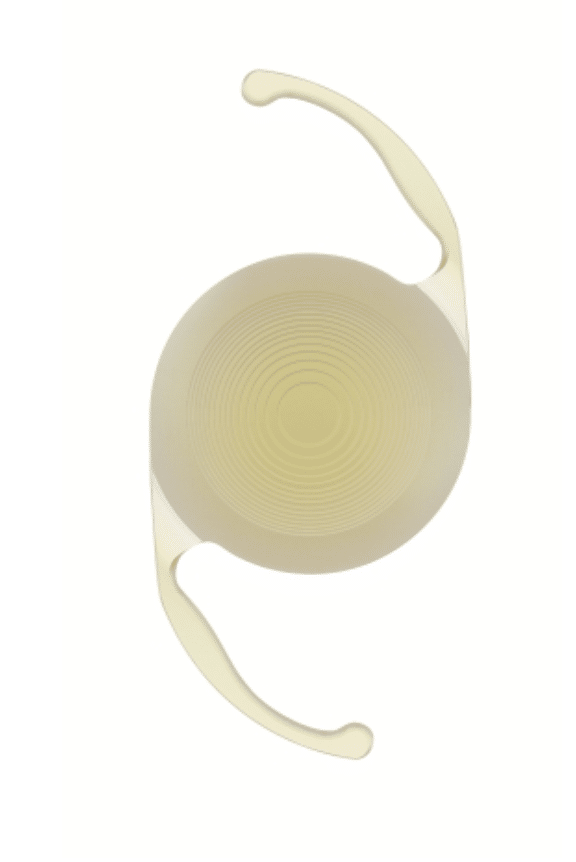
AcrySof IQ PanOptix trifocal IOL
KEY DATA POINT
The Cochrane trifocal-versus-EDOF comparison included five studies and 233 people who completed three to six months of follow-up (Tavassoli et al., 2024 [9]).
KEY TAKEAWAY
If you read small print for hours or depend on night driving, ask your surgeon to explain the likely compromise in your own case.
DIRECT ANSWER
It offers the strongest chance of useful unaided near vision among the main lens categories, but glasses can still be needed. Halos and glare are part of the decision, especially if you drive often after dark.
Trifocals split light to support far, intermediate and near focus. PanOptix, AT LISA tri and FineVision are examples studied in the cataract trials reviewed by Cochrane. That review suggested better near vision than Symfony EDOF, with similar distance acuity, but judged the evidence low certainty and short-term (Tavassoli et al., 2024 [9]).
In a broader review, multifocal lenses reduced spectacle dependence compared with monofocals, while glare and halos were more common (Khandelwal et al., 2019 [3]). Those pooled studies include older lens designs, so they should inform a conversation, not predict the result of a particular 2026 trifocal.
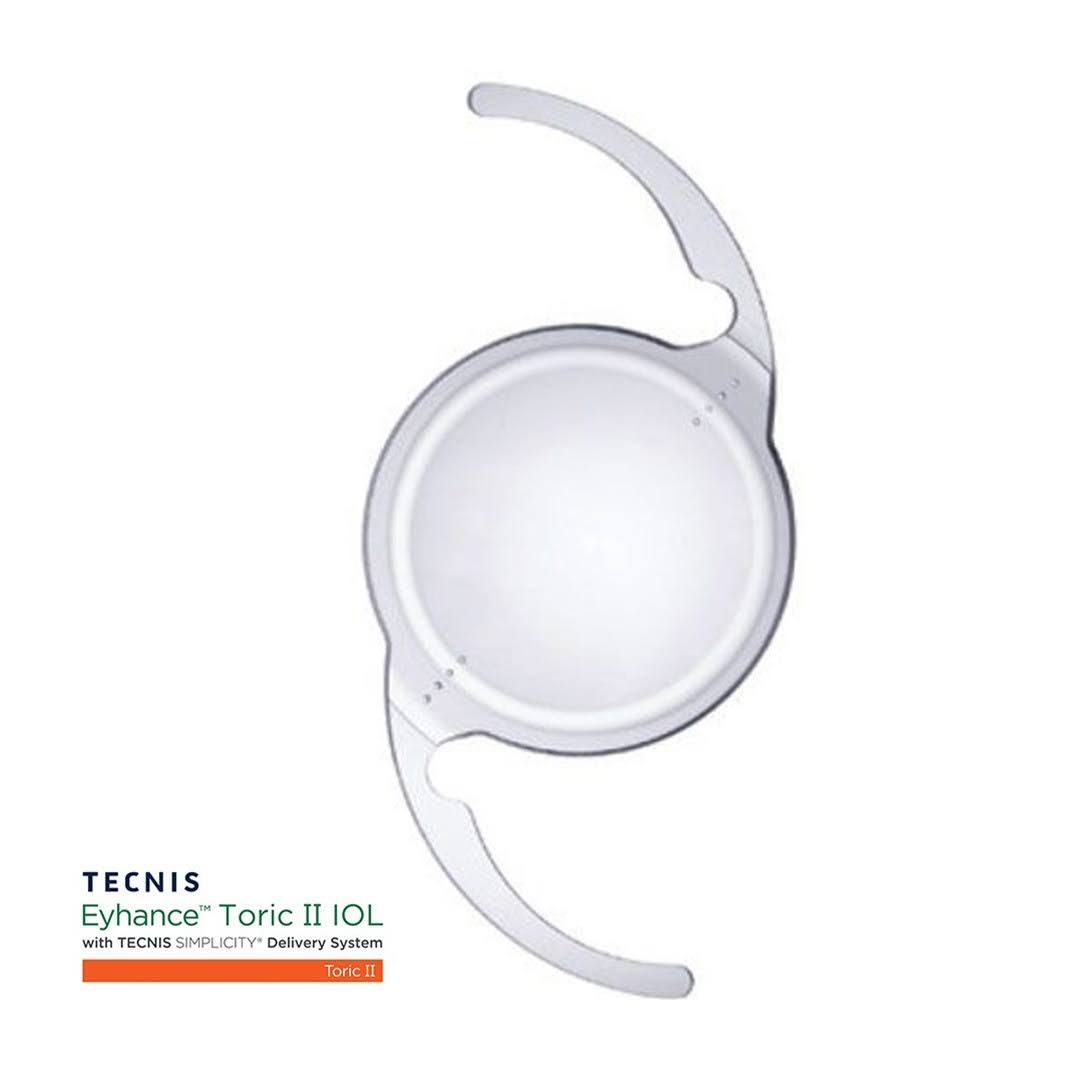
TECNIS Eyhance Toric II IOL
KEY DATA POINT
The 2024 Academy review included 12 level-I and nine level-II studies of toric monofocal lenses (Al-Mohtaseb et al., 2024 [1]).
KEY TAKEAWAY
Ask for your measured corneal astigmatism and the predicted remaining prescription with and without a toric lens.
DIRECT ANSWER
A toric IOL can reduce regular corneal astigmatism during lens surgery and improve unaided vision. It is an addition to the lens design, not a rival to monofocal, EDOF or trifocal.
Astigmatism means the eye focuses differently in different directions. A toric lens adds a matching correction, which must be planned from careful corneal measurements and aligned during surgery.
In an American Academy of Ophthalmology review of 21 studies, toric monofocals gave better unaided distance vision and less remaining astigmatism than non-toric monofocals, with a clearer advantage over corneal relaxing incisions at higher levels of astigmatism (Al-Mohtaseb et al., 2024 [1]). A 2026 review reached the same broad conclusion for significant astigmatism (Verstraaten et al., 2026 [11]).
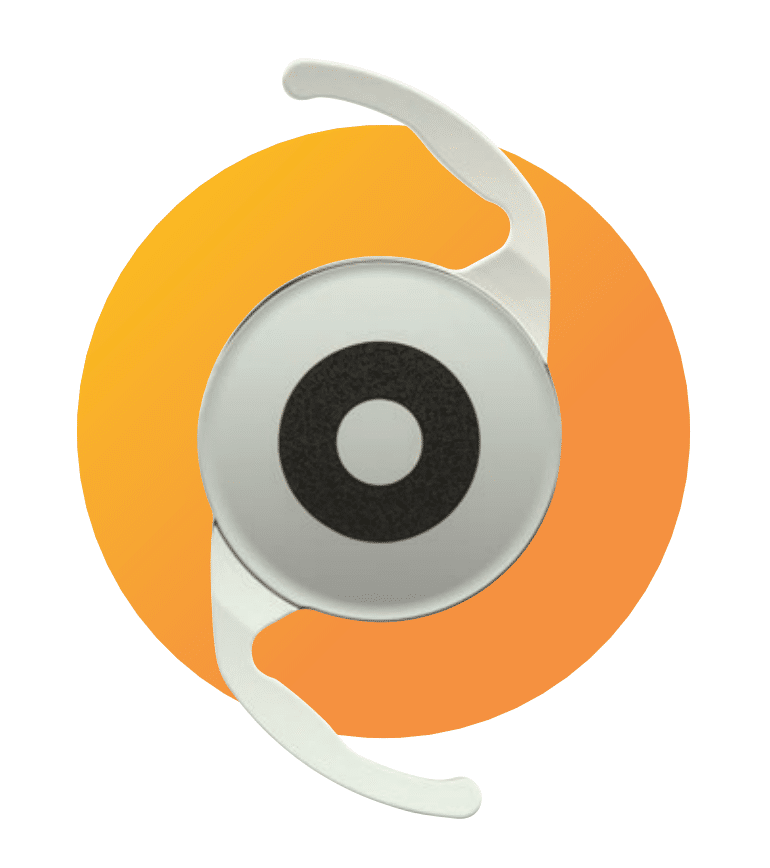
IC-8 Apthera small-aperture (pinhole) IOL
KEY DATA POINT
The small-aperture review included 22 studies, with varying designs and patient groups (Sánchez-González et al., 2022 [7]).
KEY TAKEAWAY
Do not choose an implant because it is the newest item on a list. Choose it because its published results fit your eye and your priorities.
DIRECT ANSWER
Yes, but they are specialist discussions. Small-aperture lenses and accommodating designs exist; the evidence and UK availability are less settled than for the principal choices above.
A small-aperture lens uses a pinhole effect to extend focus and may be considered for selected irregular corneas. A systematic review found promising results, but the studies varied, and many were case series (Sánchez-González et al., 2022 [7]).
Accommodating lenses aim to change focus with the eye, but they have a smaller and less consistent comparative evidence base than established presbyopia-correcting categories (Cho et al., 2022 [2]). "New" is not a clinical outcome. Ask for peer-reviewed results for the exact model and whether it is available in the UK.
DIRECT ANSWER
The IOL categories are similar, but the decision to operate is different. RLE removes a clear natural lens for vision correction, so the alternatives and lifetime consequences deserve a separate discussion.
If you have a cataract that is affecting life, lens replacement treats the clouding and gives an opportunity to choose the refractive target. If your lens is clear, the Royal College of Ophthalmologists advises comparing RLE with glasses or contact lenses, laser vision correction and phakic IOL surgery, which leaves the natural lens in place (RCOphth, 2024 [13]). High short-sightedness needs particular retinal risk assessment before RLE.
Previous LASIK or other corneal laser treatment makes IOL power calculation less predictable. NICE advises modified calculations and a frank discussion about the possibility of needing glasses or another procedure afterwards (NICE NG77, recommendations 1.3.6-1.3.7 [12]). Bring your old prescription or laser records if you have them.
KEY DATA POINT
NICE explicitly requires a discussion of the refractive implications of different lenses and the patient's chosen outcome before cataract surgery (NICE NG77, recommendation 1.5.3 [12]).
KEY TAKEAWAY
For RLE, make the first decision about whether to replace your natural lens at all. Make the IOL decision second.
DIRECT ANSWER
First find the cause. A remaining prescription, dry eye or clouding behind the implant can all affect vision; in selected cases an IOL can be exchanged, but that means another operation.
It matters because an implant is not a pair of glasses you can simply take off. An examination can separate a lens-optics problem from a treatable focusing error or an eye-surface problem. The Royal College of Ophthalmologists describes treatment for residual defocus and posterior capsule opacification, or PCO, the clouding of the membrane behind the implant. It also describes lens exchange for the small group who cannot adapt to a multifocal lens (RCOphth, 2024 [13]).
KEY DATA POINT
In one Cleveland Clinic series of 493 recipients of presbyopia-correcting IOLs, around 1 in 40 patients underwent a lens exchange (2.4%). It is a major procedure to swap out an implant. That is one centre's retrospective result, not a prediction for your eye (Susanna et al., 2025 [8]).
KEY TAKEAWAY
Before surgery, ask who will investigate a disappointing result and which remedies would be realistic for you.
DIRECT ANSWER
NHS cataract surgery usually uses a monofocal lens. NICE currently advises against offering multifocal IOLs for cataract surgery; toric access varies by NHS service.
The distinction matters because a lens can be clinically available in the UK without being routinely supplied by the NHS. NICE NG77 (recommendation 1.4.2 [12]) says not to offer multifocal IOLs for cataract surgery, although NICE says it plans to update its lens-selection recommendations after its 2025 surveillance review. Local toric policies differ: Imperial College Healthcare NHS Trust describes offering monofocal or toric lenses, while Kingston and Richmond NHS Foundation Trust says it does not offer toric lenses.
KEY DATA POINT
NICE's most recent surveillance, dated May 2025, plans an update to intraocular lens selection guidance but leaves the current recommendation in place until that update is issued (NICE NG77 [12]).
KEY TAKEAWAY
Ask your NHS cataract team which lens types it offers before assuming a private option is or is not available locally.
DIRECT ANSWER
Tell your surgeon what you do every day, then let the eye examination narrow the field. A lens that looks ideal on a brochure may be a poor match for your cornea, retina or night-driving needs.
In our view, the surgeon and measurements come first. We would want the discussion to cover your reading distance, computer distance, night driving, previous laser surgery, dry eye symptoms, retinal and glaucoma history, and the astigmatism measured across your cornea. Existing corneal disease or previous corneal surgery can complicate presbyopia-correcting lens selection (McNeely et al., 2025 [6]), and NICE requires a choice based on the refractive result you want (NICE NG77, recommendation 1.5.3 [12]).
KEY TAKEAWAY
Leave the consultation knowing which tasks may still need glasses, even if surgery goes to plan.
Book your free consultation.
1. Al-Mohtaseb Z, Steigleman WA, Pantanelli SM, et al. Toric monofocal intraocular lenses for the correction of astigmatism during cataract surgery: a report by the American Academy of Ophthalmology. Ophthalmology. 2024;131(3):383-392. doi:10.1016/j.ophtha.2023.10.010
2. Cho JY, Won YK, Park J, et al. Visual outcomes and optical quality of accommodative, multifocal, extended depth-of-focus, and monofocal intraocular lenses in presbyopia-correcting cataract surgery: a systematic review and Bayesian network meta-analysis. JAMA Ophthalmol. 2022;140(11):1045-1053. doi:10.1001/jamaophthalmol.2022.3667
3. Khandelwal SS, Jun JJ, Mak S, et al. Effectiveness of multifocal and monofocal intraocular lenses for cataract surgery and lens replacement: a systematic review and meta-analysis. Graefes Arch Clin Exp Ophthalmol. 2019;257(5):863-875. doi:10.1007/s00417-018-04218-6
4. Kim DY, et al. Comparative outcomes of an EDOF and an enhanced monofocal intraocular lens. J Clin Med. 2025;14(14):4967. doi:10.3390/jcm14144967
5. Loh NC, Pothakamuri TK, Chen DZ. Enhanced monofocal versus conventional monofocal intraocular lenses: a systematic review and meta-analysis of randomised controlled trials. Can J Ophthalmol. 2026;61(1):12-19. doi:10.1016/j.jcjo.2025.07.010
6. McNeely RN, Moore JE, Mehta JS, Ting DSJ. Presbyopia-correcting intraocular lenses in eyes with corneal conditions: an update. Curr Opin Ophthalmol. 2025. doi:10.1097/ICU.0000000000001175
7. Sanchez-Gonzalez JM, et al. Small-aperture IC-8 extended-depth-of-focus intraocular lens in cataract surgery: a systematic review. J Clin Med. 2022;11(16):4654. doi:10.3390/jcm11164654
8. Susanna BN, et al. Prevalence of presbyopia-correcting intraocular lens satisfaction, dissatisfaction and intolerance. J Refract Surg. 2025. doi:10.3928/1081597X-20250915-03
9. Tavassoli S, Ferris JD, Dyer AK, et al. Trifocal versus extended depth of focus (EDOF) intraocular lenses after cataract extraction. Cochrane Database Syst Rev. 2024;7:CD014891. doi:10.1002/14651858.CD014891.pub2
10. Teus MA, et al. Visual and participant-reported outcomes of a wavefront-shaping EDOF intraocular lens implanted bilaterally with monovision. J Cataract Refract Surg. 2025;51(7):549-556. doi:10.1097/j.jcrs.0000000000001636
11. Verstraaten JWH, et al. Correcting astigmatism using toric intraocular lenses during cataract surgery. Am J Ophthalmol. 2026;286:248-262. doi:10.1016/j.ajo.2026.02.043
12. National Institute for Health and Care Excellence. Cataracts in adults: management. NICE guideline NG77 (including May 2025 surveillance status). nice.org.uk/guidance/ng77
13. The Royal College of Ophthalmologists. Refractive lens exchange: patient information. 2024. rcophth.ac.uk/guidance-resources/refractive-lens-exchange
This is general information for choosing questions to discuss with your eye surgeon. The lens model, focus target and suitability can only be decided after an individual examination. Brand names are examples of lens designs studied in published research and are not a statement of Focus Clinic stock or UK-wide availability.
* 100% 20/20 success is from our peer-reviewed published results for LASIK binocular vision treating short-sight up to -6.00 dioptres including up to 2.00 dioptres of astigmatism.
**J Cataract Refract Surg. 2023 Nov 1;49(11):1140-1146. Ray-tracing-guided myopic LASIK: real-world clinical outcomes. George He, Chandra Bala




100% SUCCESS RATE
10 YEAR GUARANTEE
#1 IN THE UK TRUSTPILOT RATING
CELEBRITIES CLINIC OF CHOICE

Registered in England 4585464
Focus Clinic © 2025