Book Your FREE Telephone Consultation
Mr David Allamby
MD, FRCOphth, FRCS

LASIK is the most popular type of laser eye surgery worldwide.
Book Your FREE
Telephone Consultation
We can give you a good idea of your suitability over the phone and schedule you for an initial consultation.
Researchers in Greece first described LASIK in 1990, and it uses a blade-like device to cut a thin flap in the front of the cornea. [1]
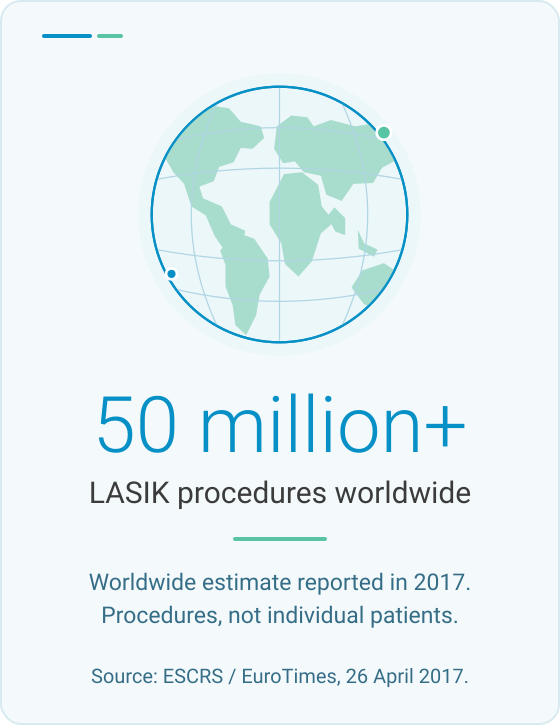
One review reports that 40 million LASIK procedures were carried out worldwide between 1991 and 2015, not including PRK, SMILE or later years. Today, the total may exceed 50 million eyes. [2] The procedure has evolved significantly over the last 30 years.
Today, a femtosecond laser has largely replaced the blade, although some clinics still use a mechanical microkeratome to create the flap. At Focus Clinic, we use a Swiss-made Ziemer femtosecond laser. The American Academy of Ophthalmology report judged femtosecond lasers as good as or better than blades for making flaps. [3]
Modern LASIK now uses two lasers to reshape the cornea and correct vision. The femtosecond laser first creates a thin flap on the cornea’s surface. The excimer laser then reshapes the underlying tissue before the surgeon returns the flap to its original position. [5]
This page explains:
For a comprehensive understanding of the treatment, including suitability, results and treatment options, see our LASIK eye surgery page.
LASIK works by changing the cornea’s curvature so light entering the eye focuses correctly on the retina.
The excimer laser makes all this possible. In the 1980s, researchers showed that an ultraviolet excimer laser could remove microscopic amounts of corneal tissue by a process called photoablation. This occurred without significantly heating the surrounding tissue. [4] Every LASIK and PRK procedure since has been built on this.
Once reshaping is complete, the flap returns to its original position and seals naturally without stitches. [5,6]
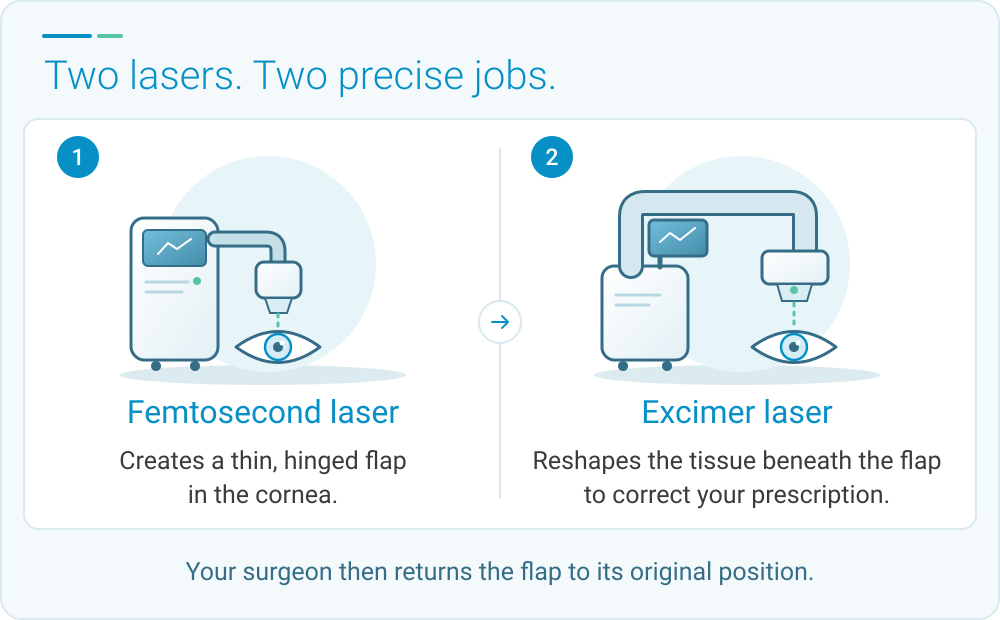
A femtosecond laser creates a thin corneal flap, giving the surgeon access to the tissue underneath.
This is the key difference between LASIK and surface laser procedures such as LASEK or PRK, which do not create a corneal flap.
The excimer laser removes microscopic amounts of tissue to change the cornea’s curvature.
For short-sightedness, tissue is removed from the centre of the cornea to flatten it. For long-sightedness, tissue is removed from the periphery and the curvature is increased. In astigmatism, an irregular corneal curve is reshaped to become more symmetrical. [3,5,8]
✓Around five minutes per eye
✓Both eyes are usually treated at the same appointment
✓Anaesthetic drops are used to numb the surface
✓A thin corneal flap is created with a femtosecond laser
✓Microscopic amounts of corneal tissue are removed by the excimer laser
✓No stitches required
✓The flap is repositioned at the end [5,6]
Speak To The Team
We can give you a good idea of your suitability over the phone and schedule you for an initial consultation.
The LASIK procedure is quick, but there are several stages between lying down on the laser bed and completing treatment.
Anaesthetic eye drops are applied to fully numb the surface of the eye. [5,6]
You remain awake during the procedure, but you should not feel pain while the lasers are working. No injections are given into the eye.
If you are particularly nervous, medication such as diazepam can be provided to help you relax.
You lie back on the laser bed, positioned so you can see a small blinking fixation light. [6]
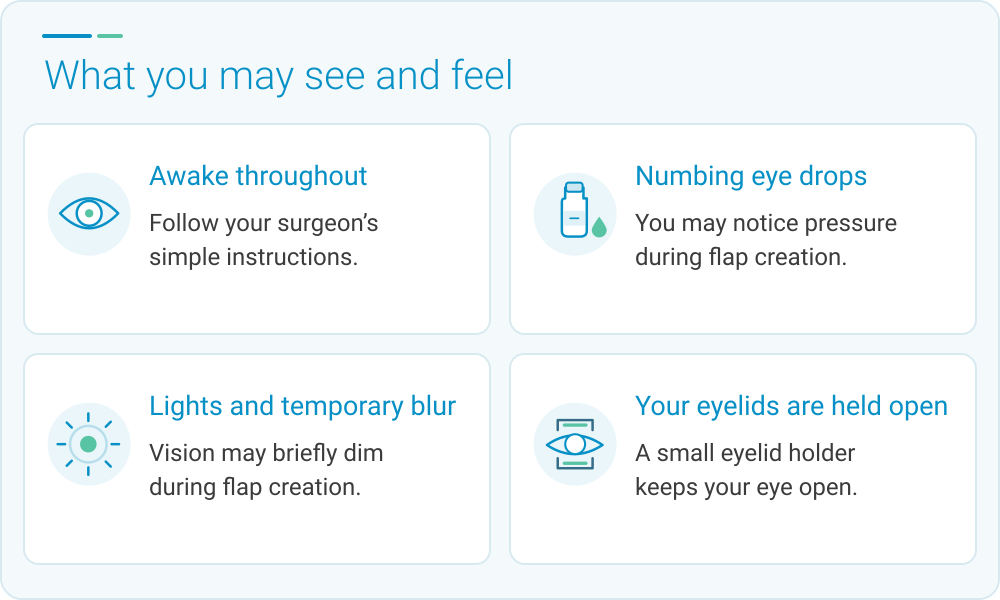
A small speculum keeps your eye open during treatment.
You don’t need to try to stop yourself from blinking. The eyelid holder keeps your eye open while you simply look at the fixation light. It will feel like you are still blinking normally.

Your surgeon first uses a femtosecond laser to create a thin, circular “flap” in the uppermost layer of the cornea. (N.B. some clinics still use a mechanical blade tool called a microkeratome for this step, but this is outdated and should be avoided).

This cool ultraviolet laser changes the cornea's curvature (without heat) by evaporating microscopic amounts of tissue. The new shape creates clear vision by correctly focusing light onto the retina inside the eye. For short-sightedness, the cornea is made flatter, whereas for long-sightedness it is made steeper.
LASIK eye surgery, like PRK, can also correct astigmatism by smoothing a rugby ball-shaped cornea into a rounder, more normal shape. A common myth is that LASIK eye surgery cannot treat astigmatism.
After the laser reshapes the cornea, the flap is then folded back into position, covering the area where the corneal tissue was removed. The cornea is then allowed to heal naturally.


At Focus Clinic, our team has over 70 years of combined industry experience and has completed over 60,000 successful surgeries.
Want to see real reactions from real people, just moments after they've had laser eye surgery?
At Focus Clinic, we can plan LASIK using ray-tracing technology that creates a highly detailed digital model of your eye. Rather than planning treatment based on a glasses prescription alone, ray tracing measures how light travels through the eye and lets the surgeon personalise the treatment pattern before surgery. [7,8]
Your surgeon performs more than 150 steps on each eye during the LASIK procedure.
The surgeon carries out around 90% of the treatment manually, with the lasers active for only around 10% of the procedure.
This is why the surgeon’s experience remains essential, even when advanced laser technology is being used. The technology is only one part of the procedure; your surgeon carries out the assessment, preparation, positioning, flap handling, checks and other stages around the relatively short periods when the lasers are active.
Focus Clinic has a 100% 20/20 vision success rate for all common short-sighted prescriptions using binocular vision. [12] Published data on the ray-tracing-guided LASIK technique achieved 100% 20/20 for all single eyes, a higher outcome than for binocular vision. [7]
Speak To The Team
We can give you a good idea of your suitability over the phone and schedule you for an initial consultation.
The LASIK procedure itself is remarkably quick.
The reshaping takes seconds per eye, and you are in the laser suite for only around 20 minutes.
The surgery itself takes approximately 10–12 minutes for both eyes. Most of the time in the laser room is spent on preparation and positioning, not on the lasers actively treating the cornea.
Your full clinic appointment will be longer because we do checks beforehand, and you will receive postoperative instructions before you go home.
Yes. You are awake throughout LASIK eye surgery. [6]
Anaesthetic eye drops numb the eye’s surface, so you don't need a general anaesthetic. Being awake also lets you follow simple instructions, such as looking toward the fixation light during treatment.
You don’t need to keep your eyes open or worry about blinking because the eyelid holder does that for you.
LASIK should not normally be painful because anaesthetic eye drops numb the eye before treatment begins. [6]
You may feel pressure for about 20–30 seconds while the flap is created, but you won’t feel the excimer laser as it reshapes the cornea.
Once the anaesthetic wears off, the eyes can feel watery, gritty or heavy for several hours. We provide anaesthetic drops in your take-home pack, should you need relief during those first few hours.
Getting my laser eye surgery with Focus was the best decision I ever made. They were so professional and thorough from start to finish. I was clearly informed of all steps from start to finish and on the day of the surgery I was looked after so well, Dr Allamby did an amazing job, it was so quick, easy and painless that I didn't even know it had happened at first!
It's been 3 months since I had my laser eye surgery and I can confirm that the results have been impeccable! The team have always been very professional, attentive and caring. All the aftercare advice provided has really helped my eyes to heal and I can confidently say that they feel more than brand new.
It's been 5 years since i've had laser eye surgery done and it is honestly the best amount of money I have ever spent in my life. I've been suffering for years wearing contact lenses and glasses with constant headaches and dry eyes...For anyone wondering if they should do it, please please please go ahead and do it!
Many patients worry more about what they will see or feel than about the laser's technical details. [6]
You will see lights during treatment, although your vision may temporarily blur or dim at different stages. During flap creation, you’ll likely notice pressure rather than pain.
When the excimer laser is working, you may hear a soft sound and notice a faint smell. You should not feel heat or pain from the laser.
The eyelid holder means you don’t have to worry about blinking, while the laser’s eye-tracking system follows the small movements your eye naturally makes.
Once both eyes have been treated, you will have a short period to rest before leaving the clinic.
Vision may still be hazy initially, and your eyes may water or feel gritty as the anaesthetic wears off. [6]
You will receive postoperative eye drops and instructions on caring for your eyes during the early healing period. You should arrange for someone to take you home because you cannot drive on the day of treatment.
For the full recovery timeline, including returning to work, driving, exercise, swimming and aftercare appointments, see our LASIK Recovery and Aftercare guide.
The flap begins to heal immediately after repositioning. Surface skin cells begin sealing the flap edge within the first few hours. [6,9]
Healing continues after this initial sealing stage, which is why patients are advised not to rub their eyes and to follow their aftercare instructions carefully.
For more information about flap healing and possible complications, see our LASIK Safety and Risks page.
Free retreatment is available if you return to a significant prescription after the initial surgery during the first ten years.
LASIK is not suitable for every eye. Corneal thickness and shape, prescription, eye health, lifestyle and other factors can influence which form of laser eye surgery is most appropriate. [5]
To learn more about the screening process and who may or may not be suitable, see our LASIK Eligibility guide.
LASIK is a life-changing surgery that can help you see clearly and live your life to the fullest. But like any surgery, it’s important to know what to expect before, during and after the procedure.
At Focus Clinic, we want you to be as comfortable and confident as possible with your decision to have LASIK surgery. That’s why we offer free LASIK consultations, so you can learn more about the procedure and ask any questions you may have.
To book a free LASIK consultation with one of our expert surgeons, please click the button below.
Focus Clinic’s chief surgeon, Mr David Allamby, MD, wrote and reviewed these LASIK answers and has performed laser eye surgery for over 25 years. Focus Clinic is an Alcon-named Centre of Excellence and European training centre for ray-tracing-guided LASIK.
You do not need to keep your eyes open yourself. A small eyelid holder gently keeps the eyelids apart throughout treatment, so blinking will not interrupt the procedure. [5,6]
The WaveLight EX500 used at Focus has a high-speed 1050 Hz-type eye tracker, synchronised with its 500 Hz laser pulse frequency. This means that the laser system can follow small involuntary eye movements and keep treatment centred on the correct part of the cornea. [8]
If your eye moves outside the treatment area, the laser system can interrupt treatment until the eye is correctly positioned again.
The lasers are active for only a small part of the overall procedure. Creating the flap takes seconds, while the excimer laser usually reshapes the cornea in a few additional seconds, depending on the prescription being treated.
Yes. LASIK is usually performed on both eyes during the same appointment. Each eye is treated separately, one after the other. [5,6]
You should not feel pain because your eye has already been numbed with anaesthetic drops. You may notice firm pressure for a short period while the femtosecond laser creates the flap. [5,6]
Once the excimer laser has finished reshaping the cornea, the flap is returned to its original position. It naturally adheres to the underlying corneal tissue, so stitches are not required. [5,6]
You will see lights and changing patterns of brightness while you lie beneath the laser. Your vision may temporarily blur or dim during flap creation, but you will not see the laser physically reshaping the cornea.
LASIK eye surgery is performed using two lasers. A femtosecond laser creates a thin flap in the cornea, an excimer laser reshapes the tissue underneath, and the flap is then returned to its original position.
Book a FREE* Consultation
To get a better idea of how we can help you, and also the different types of services we offer, book a consultation now.
100% 20/20 vision
Focus Clinic has a remarkable 100% success rate for 20/20 vision. We know of no other clinic that has matched these results. There is a big difference between, for example, 98% and 100% success, especially if you are in the 2%.

10 year guarantee
Your 10 Year Guarantee means you can return at any time if you have additional questions on the quality of your vision. If you have distance vision correction for short-sight then any repeat laser eye treatments to correct a return of myopia in the first 10 years are included free of charge.*
Most trusted eye treatment clinic
We have the highest trust rating of any ‘eye treatment’ rated clinic, according to independent review site TrustPilot. With an outstanding 4.9 out of 5, when it comes to your eyes, choose the clinic that actual patients trust the most.
*Terms and conditions apply, excludes any age-related changes and conditions unrelated to the primary treatment

An official Alcon Center of Excellence and European training hub for Ray-Tracing Guided LASIK - the first of its kind in the UK, delivering 20/20 vision in 100% of treated eyes based on published clinical research.
22 Wimpole Street,
London W1G 8GQ, UK
0207 307 8250
100% SUCCESS RATE
10 YEAR GUARANTEE
#1 IN THE UK TRUSTPILOT RATING
CELEBRITIES CLINIC OF CHOICE