
Medically reviewed by Mr David Allamby, FRCOphth, Founder and Lead Surgeon, Focus Clinics
Last updated: 1 October 2026
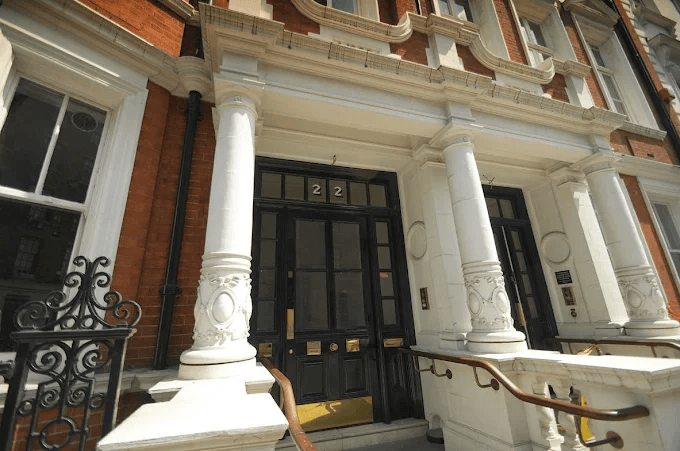
Focus Clinics is based at 22 Wimpole Street, in the heart of London’s Harley Street medical district, but many of our patients travel to us from outside London and overseas.
For some, it is the opportunity to access a treatment or technology that is not available closer to home, such as ray-tracing-guided LASIK. Others come for a specialist assessment after being told elsewhere that their prescription, corneal thickness or eye health could make treatment more complicated.
If you’re considering eye surgery at Focus Clinics and don’t live nearby, this guide explains what to expect. It covers planning your visit, how long you may need to stay, travelling after surgery and what happens with your follow-up care once you return home.
Why Patients Travel to Focus Clinics
Travelling for eye surgery requires more planning than choosing a clinic close to home, so you need a good reason to make the trip. Some of the reasons patients come to Focus include:
- Access to specialist eye surgery. Focus offers laser- and lens-based vision correction, with treatment recommended based on your eyes, prescription, age, and suitability, rather than a single procedure being right for everyone.
- Ray-Tracing Guided LASIK. Focus is currently the only clinic in the UK offering this technology. It uses detailed measurements to create a personalised 3D digital model of the eye before treatment is planned.
- European Centre of Excellence. Focus is an accredited European Centre of Excellence for laser eye surgery by global laser manufacturer Alcon.
- A second opinion on a complex prescription. If you’ve been told elsewhere that your prescription is too high, your corneas are too thin or you aren’t a straightforward candidate, a specialist assessment can establish whether another treatment option may be appropriate.
- Our team of surgeons brings extensive experience. Focus founder and lead surgeon Mr David Allamby has specialised in refractive eye surgery for over 25 years, including treating complex prescriptions and patients referred after previous surgery. His guiding ethos sets the standard for our surgical team.
An Alcon Centre of Excellence and European Training Centre
Focus Clinics was the first clinic in the UK to offer ray-tracing-guided LASIK and is an Alcon-named Centre of Excellence and European training centre for the technology.
Ray-tracing-guided LASIK (wavelight plus) uses detailed measurements of the complete optical system to create a three-dimensional digital model of each eye. This model helps the surgeon test and plan a treatment specific to that individual eye rather than relying only on the glasses prescription.
Focus’s role as a European training centre also reflects its experience with the technology and its use in clinical practice.
If you’re considering travelling specifically for ray-tracing-guided LASIK, you can read more about how ray-tracing-guided LASIK works.
Which Treatments Might Patients Travel to Focus For?
Travelling to Focus doesn’t necessarily mean having LASIK. The right procedure depends on your eyes, prescription, age, lifestyle and the results of your assessment.
Options available at Focus include:
- Ray-Tracing Guided LASIK (or PRK/LASEK) is a personalised form of laser vision correction planned using a 3D digital model of the eye.
- LASIK, which reshapes the cornea beneath a thin corneal flap, typically has a relatively fast initial recovery.
- LASEK/PRK, surface laser treatments that may be considered for some people who are not suited to LASIK, including certain patients with thinner corneas.
- Implantable Contact Lenses (ICLs), which may be an option for patients with prescriptions unsuitable for laser correction.
- Refractive Lens Exchange (RLE), a lens-based procedure that may be considered for people whose age, prescription or changing reading vision makes laser treatment less suitable.
Your assessment will determine which is appropriate for you.
Planning Your Visit: How Long Do I Need to Stay?
No single stay length applies to everyone.
Recovery differs meaningfully among LASIK, PRK/LASEK, ICL, and RLE, and the number and timing of appointments can also vary.
As a guide, your visit will usually involve three stages:
- Assessment. You’ll have a detailed suitability assessment and diagnostic testing. If you’re considering the most advanced ray-tracing guided LASIK (wavelight plus), this will include Sightmap imaging to collect the measurements needed for treatment planning.
- Treatment. If you’re suitable and decide to proceed, your surgery will take place according to the treatment plan agreed with your surgeon.
- Follow-up. You’ll need post-operative checks so the clinical team can assess your early recovery before you continue with the rest of your aftercare.
How long you need to stay will depend on the procedure, your recovery, and the timing of the required follow-up appointments.
Travelling to Focus From Elsewhere in the UK
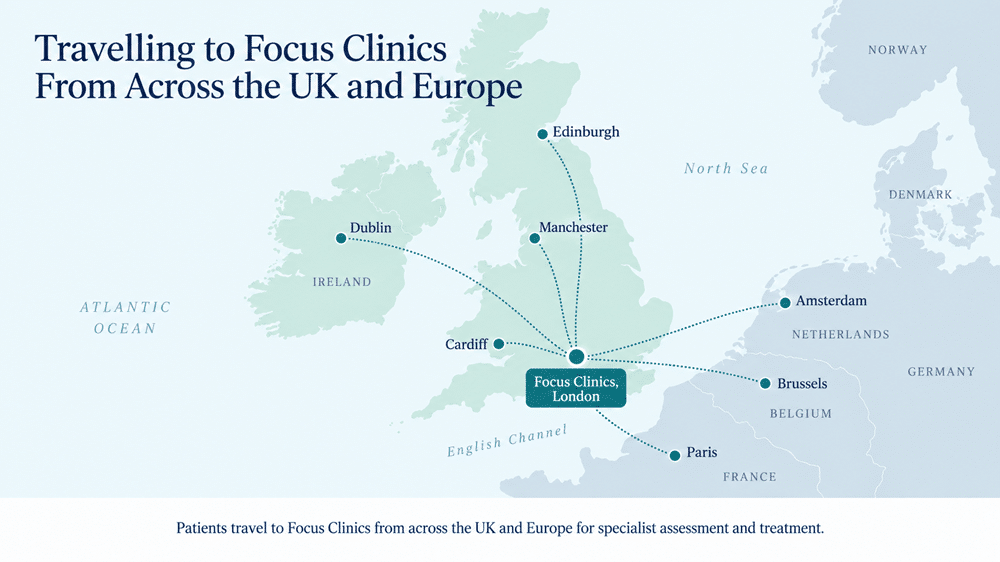
Patients travel to Focus from across the UK, including the Midlands, northern England, Scotland, Wales, the South West and areas outside London in the South East.
For patients travelling by train, London’s mainline stations provide straightforward connections to the West End, while those travelling longer distances may choose to stay locally depending on their procedure and appointment schedule.
We are close to Euston, Kings Cross, St Pancras International, and Paddington stations.
Download our handy PDF map with directions to 22 Wimpole Street, including nearby Underground and National Rail stations, bus routes, parking and driving information.
Download the Focus Clinics Directions Map (PDF)
Travelling From Europe or Further Afield
Focus also sees patients who travel to London from outside the UK.
London has direct rail and air links to much of Europe, including Eurostar services to St Pancras International and flights to London’s major airports. The rapid Elizabeth Line connects Heathrow Airport to central London, with the nearest walkable station to the clinic being Bond Street.
International patients should consider:
- How many in-person appointments are likely to be required
- How long they will need to remain in London after treatment
- When flying is appropriate after their procedure
- How subsequent aftercare will be managed
- Whether UK visa or entry requirements apply
These practical details can vary depending on the treatment, so they should be part of the planning process, not an afterthought.
Do I need a visa to come to the UK for eye surgery?
Visa and entry requirements depend on your nationality and can change over time. Check the current requirements for your circumstances directly on the official GOV.UK visa checker rather than relying on general travel guidance.
Getting to Wimpole Street
Focus Clinics is located at:
22 Wimpole Street
London
W1G 8GQ
The clinic is in London’s Harley Street medical district, close to Oxford Circus and Regent’s Park Underground stations.
If you’re arriving by train from elsewhere in the UK, London’s mainline stations connect easily with the West End by Underground, taxi and other public transport.
Patients travelling from continental Europe can arrive at St Pancras International by Eurostar, while London’s airports connect to destinations across Europe and further afield.
Need help finding us?
Download our PDF map for directions to Focus Clinics by Underground, train, bus or car.
For live journey planning and service information, use official sources such as Transport for London, National Rail and Eurostar.
We don’t recommend specific hotels, but Wimpole Street sits within Marylebone, a well-connected central London area with a wide range of accommodation nearby.
Can I Start the Process Before Travelling to London?
Yes. You don’t necessarily need to arrange a trip simply to make your first enquiry.
Focus offers a free telephone consultation, which can give you an initial idea of whether vision correction may be suitable and help determine the next step.
A telephone conversation cannot confirm your suitability for surgery. That requires the appropriate in-person examination, measurements and diagnostic testing.
However, speaking to the team first can be particularly useful if you’re several hours from London or coming from overseas, as you can discuss your prescription, previous eye surgery, medical history, and travel circumstances in advance.
Recovery, Aftercare and Travelling Home
For anyone travelling to London for eye surgery, a common question is what happens after the procedure.
Recovery varies by treatment, so travel advice should be based on your procedure and how your eyes are recovering.
Your First Follow-Up
An early post-operative examination lets the clinical team check your eyes and make sure your initial recovery is progressing as expected.
The timing of this appointment depends on the procedure.
LASIK and surface treatments such as PRK/LASEK have different early recovery patterns, while lens procedures such as ICL and RLE have their own follow-up requirements.
After laser eye surgery, you will need to have a mandatory in-person follow-up. For LASIK, this is the following day, and for PRK/LASIK, it is approximately 4 days later.
Travelling Home Within the UK
If you’re returning home by train or as a passenger in a car, the clinical team can advise when it is appropriate to travel.
Don’t assume you’ll be able to drive yourself after surgery. When you can legally and safely resume driving depends on your vision and your clinician confirming that you meet the required visual standard.
Allow for the possibility that your eyes may feel tired, sensitive or uncomfortable during the early recovery period, particularly following procedures with a slower initial healing phase.
Flying After Eye Surgery
If you’re coming from another country, flying after eye surgery is likely to be one of your main practical concerns.
There isn’t a single timeframe that safely applies to LASIK, PRK/LASEK, ICL and RLE. Your procedure, your early examination and your individual recovery all matter.
Flying in itself is not a problem after laser eye surgery. Cabin air is dry, which may matter during recovery from some eye procedures. Take a small vial of lubricating drops with you on the plane. Follow the advice and eye-drop schedule given to you by your clinical team.
What Happens to My Aftercare When I Get Home?
Travelling for eye surgery shouldn’t mean sacrificing follow-up care.
Before you finish your initial treatment period, make sure you understand:
- When your next review is due
- Which appointments need to take place at Focus
- What symptoms or concerns should prompt you to contact the clinic
- How to contact the clinical team from home
- Whether any later checks can be coordinated locally
We can coordinate your follow-up with your local optometrist or ophthalmologist when returning to London is impractical.
Is Travelling for Eye Surgery Worth It?
For some people, treatment close to home is the simplest option. For others, travelling can provide access to a particular surgeon, technology or treatment that isn’t available locally.
It may also be worth seeking a second opinion if you’ve previously been told you’re unsuitable for vision correction, particularly where the decision involved a high prescription, thin corneas, previous surgery or another factor that requires more specialist assessment.
If you’re comparing Focus with a local clinic or even considering laser eye surgery abroad, think beyond the treatment day itself.
Consider:
- the experience of the surgeon
- whether the treatment you’re interested in is available
- access to the latest technology, such as ray-tracing-guided LASIK
- how thorough the assessment process is
- recovery time
- follow-up requirements
- what happens if you need further advice once you’re home
- the practical cost and time involved in travelling
The best option isn’t automatically the clinic closest to you or the one furthest away. What matters is whether the treatment, clinical team and aftercare are right for your circumstances.
What Do Patients Who Travel to Focus Say?
1) Why I chose Focus
“There’s no safer and better place to get LASIK eye surgery done than at Focus Clinics. I have been to other clinics and felt it was too rushed and they asked for money immediately. The clinic just looks class, clean and well kept.
I had to travel all the way down from Manchester to get it done and my father is coming all the way from the Seychelles to get his done soon too. I can’t wait to share the good news with my friends who wear glasses back home in Seychelles and I would reccomend it to them anytime.”
Sam Mancienne, Manchester
2) Great experience
“I went to Focus Clinic after doing a lot of research and having thought about laser eye surgery for years. The staff were welcoming and ready to answer any and all questions, and were particularly accommodating given that I live in Europe and had to travel for my appointments.
Life-changing experience that I would wholeheartedly recommend.”
Rebecca Buckeridge, Europe
3) Great results and a great experience
“I have wanted laser eye surgery for a long time. When the time came, and I felt ready to go ahead with the surgery, I went to my local ‘high street’ clinics for consultations.
Unfortunately, I did not feel inspired with confidence after these consultations. I wanted the best for my eyes. I went back to the drawing board and researched further – my research led me to Dr. David Allamby and the Focus Clinic; David is a surgeon of some repute.
I’m so glad that I chose Dr David Allamby and the Focus Clinic. I travelled from Scotland by myself for the surgery – despite my initial reservations about the logistics involved, it was much easier than I thought and everything has run surprisingly smoothly. I feel the additional cost and time with the travel involved is more than justified – you only have one pair of eyes!”
Richard Goddard, Scotland
Questions About Travelling to Focus?
If you’re considering eye surgery at Focus but aren’t sure how your treatment would fit around travel, accommodation or follow-up care, speak to the team.
We can answer practical questions about your visit and explain the next steps before you decide whether travelling to Focus is right for you.
Call Focus Clinics: 0207 307 8250
Or:
Frequently Asked Questions
Can I travel to Focus Clinics if I live outside the UK?
Yes. Focus can assess patients who live outside the UK. Your treatment, required appointments and recovery period will affect how long you need to be in London.
How long should I stay in London for eye surgery?
This depends somewhat on the procedure and your clinical schedule. LASIK, PRK/LASEK, ICL and RLE have different recovery and follow-up requirements. For routine LASIK laser eye surgery, post-operative check-ups at 1-day and 1-week are necessary to confirm no issues or infections.
For LASIK, PRK/LASEK, ICL and RLE, the minimum required stay is 1 week for each treatment. Patients may fly abroad thereafter, if needed.
Can I fly after laser eye surgery?
Many patients can fly after laser eye surgery, but the right timing depends on the procedure and your recovery. Your surgeon or clinical team should confirm when you can safely travel based on your post-operative examination.
Our general advice is that flying is acceptable from 7 days post-surgery, provided your eyes are kept lubricated regularly, subject to surgeon/optometrist approval at the post-operative examination.
Can I fly after ICL or RLE surgery?
Discuss flying after lens-based eye surgery with your surgeon, based on your recovery and required follow-up appointments.
Flying in aeroplanes after ICL or RLE surgery is generally acceptable from 7 days post-surgery, provided you keep your eyes lubricated regularly, subject to surgeon/optometrist approval at the post-operative examination.
Can I have my assessment and surgery during the same trip?
This may depend on the procedure, results of your assessment and Focus’s treatment schedule.
Arranging both assessment and surgery during a single trip may be possible, but it depends on the procedure type, assessment results, clinic scheduling availability, and how long the patient can stay in the country.
Can I have a remote consultation before travelling?
Focus provides a free telephone consultation for an initial indication of suitability. Dedicated video consultations or pre-travel clinical record reviews are not standard procedures or currently offered.
A full assessment and diagnostic testing still need to take place before we can safely recommend surgery.
What happens with my follow-up appointments after I return home?
Essential follow-up checks (such as 1-day, 1-week, 1-month, and 6-month intervals) take place at the London clinic. The intervals depend entirely on the procedure the patient had.
Alternative local or remote arrangements for long-distance or international patients require confirmation on a case-by-case basis. Usually, if a patient can have at least their first 2 check-ups at the clinic (e.g., 1 day and 1 week), the remaining check-ups can be with their local opticians thereafter. The results of their check-ups (if completed externally) should then be sent over to Focus to add to their patient records.
Can international patients access 0% finance?
Focus currently offers interest-free finance for eligible patients, but eligibility can depend on the finance provider’s criteria.
Interest-free finance options are subject to strict residency criteria, including at least 3 years of UK residency. Non-UK residents cannot assume eligibility until formally verified.
If the individual has not lived in the UK for a minimum of 3 years, they may ask a UK resident they know, i.e., a family member or close friend who meets the criteria, to complete the finance submission on their behalf. This will still be subject to credit checks completed by Novuna Personal Finance.
