Direct answer: Halos, glare and starbursts can occur after any form of LASIK, especially during early recovery. The evidence shows that patients who had ray-tracing-guided LASIK reported these symptoms far less often a year after surgery than before, and low-light contrast sensitivity generally improved, too. None of this means the symptoms are eliminated. A small number of patients develop new visual effects after treatment, and any honest conversation before surgery should include that.
Being able to read the smallest line on an eye chart is only one measure of good vision. For many people considering laser eye surgery, another common question is: what will my vision be like at night?
Halos around headlights, glare from bright lights, and starburst patterns can occur after LASIK, particularly during early healing.
Ray-Tracing Guided LASIK is built around a more detailed model of each eye’s optics, including the imperfections that affect vision quality, rather than just the prescription. Published data for the underlying WaveLight Plus platform shows real improvement in these symptoms over time, but not their disappearance. (1)
What Are Halos, Glare and Starbursts?
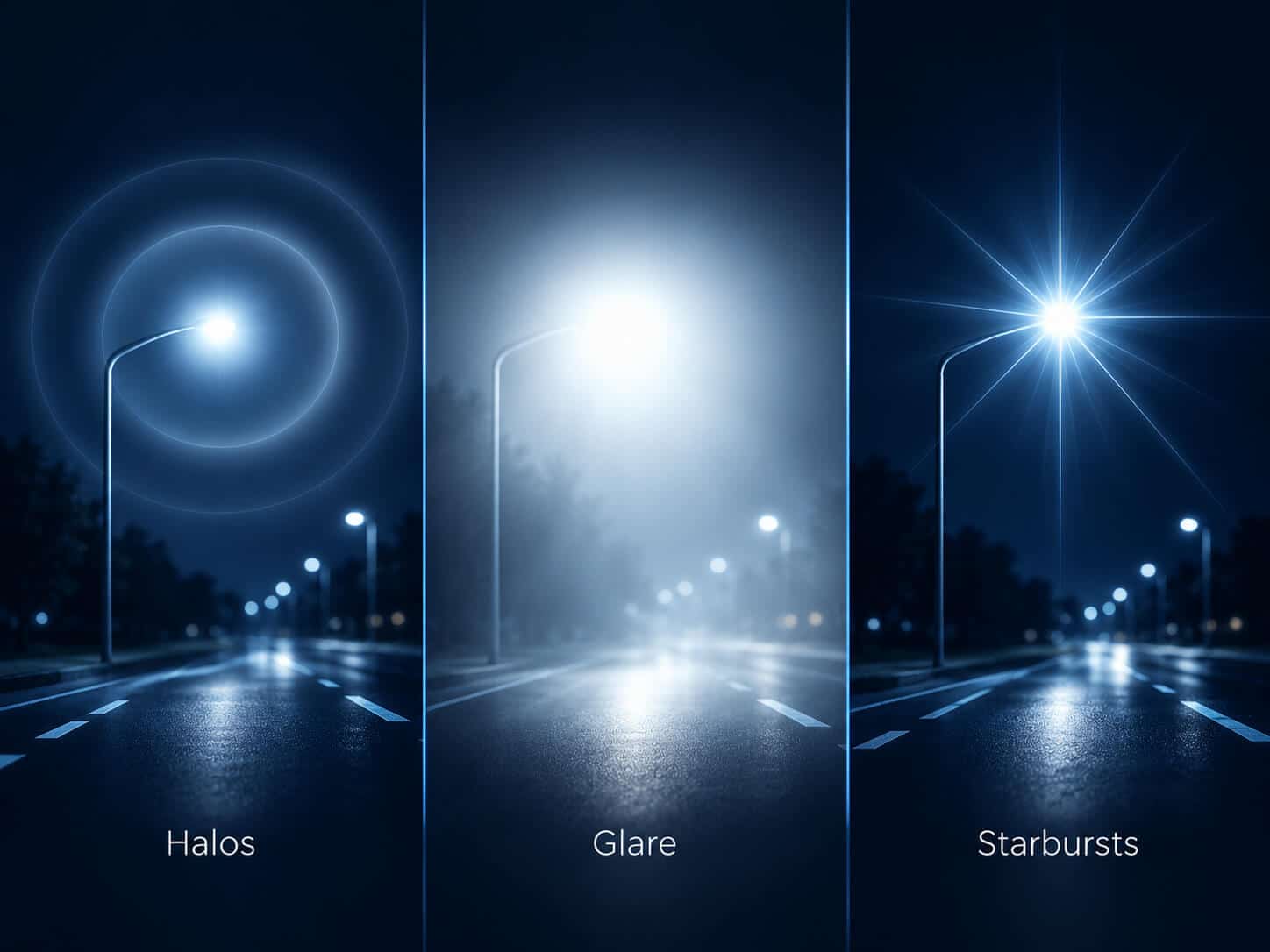
These are related but distinct visual effects. Halos are rings of light around bright objects such as headlights or streetlamps. Glare makes a light source seem too bright or makes it harder to see around it. Starbursts appear as rays or streaks radiating outward from a point of light.
They’re more noticeable at night because there’s less contrast between a light source and its dark surroundings, and because pupils dilate further in low light, letting light pass through a wider area of the eye. Good night vision depends on more than an accurate glasses prescription.
Why Can Laser Eye Surgery Affect Night Vision?
LASIK reshapes the cornea so light focuses more precisely on the retina. But refractive errors like short-sightedness and astigmatism are only part of what determines visual quality.
The eye also carries smaller optical imperfections called higher-order aberrations, such as spherical aberration, coma and trefoil. Glasses can’t correct these, and they can affect contrast, clarity, and how a point of light appears.
Research in post-LASIK eyes has found that higher-order aberrations, particularly coma and spherical aberration, can contribute to glare, halos, starbursts and double vision even when the operation appears successful on a standard high-contrast eye chart. (2, 3, 4)
So it’s possible to reach 20/20 and still notice glare, halos, or reduced contrast while driving at night.
How Does Ray-Tracing LASIK Approach This Differently?
Ray-Tracing Guided LASIK, known clinically as WaveLight Plus, plans treatment using a more detailed optical model than conventional methods.
At Focus Clinics, the Sightmap system measures how individual rays of light travel through the eye (up to 2,000) and combines this with the eye’s dimensions and optical structures to build a high-resolution, individual three-dimensional model (the “Eyevatar”).
Treatment is then planned based on that model rather than on the prescription alone, aiming to correct refractive error while accounting for aberrations that can affect night vision and contrast.
“When I plan a treatment from the prescription alone, I’m correcting the focus but leaving out the finer optical imperfections, the higher-order aberrations, that decide how clean a point of light looks in the dark. In fact, standard treatment makes these higher-order aberrations worse. For some patients, that means poor night vision.
Ray-tracing lets me model the whole eye in a way we couldn’t before, so those aberrations are accounted for in the plan instead of left to chance. That’s the part that tends to show itself when you’re driving towards oncoming headlights, and it’s the main reason I now plan on a full optical model of each eye rather than the numbers on a glasses prescription.”
— Mr David Allamby MD, FRCOphth
Ray-tracing treatment is still relatively unfamiliar to many patients, despite years of research. Our guide explores why Ray-Tracing LASIK isn’t widely known.
In a study of 400 eyes treated with this approach, all eyes reached 20/20 or better uncorrected vision at three months, and 51% reached 20/12 or better. (5)
That same study found spherical aberration decreased on average, though total higher-order aberrations rose slightly (a statistically significant but not clinically significant change, driven mainly by a small increase in coma).
It did not measure patient-reported symptoms like halos or glare; visual acuity and optical measurements are a different kind of evidence from what patients notice day to day, which is why the next section matters.
What Does the Evidence Show About Halos, Glare and Starbursts?
The clearest data comes from the FDA’s pivotal trial for this platform, which used a structured patient questionnaire before and after surgery to record what patients noticed, rather than relying only on clinical measurements. (1)
Key data point: Looking only at patients who had each symptom before surgery, most had it resolve completely by 12 months: glare resolved in 75.0%, halos in 64.4%, and starbursts in 61.7% of those who’d previously reported them. Severity fell sharply too: 13.2% of patients rated a symptom as “very” or “extremely” bothersome before surgery, versus 0.6% at 12 months. (1)
That’s the strongly positive side of the picture. The other side: among patients who had not reported a symptom before surgery, some developed one afterwards: 3.5% developed new glare, 9.7% developed new halos, and 14.5% developed new starbursts by 12 months. (1) Overall rates dropped substantially, but ray-tracing LASIK doesn’t guarantee that no one develops a new symptom.
What About Vision in Low Light?
Visual acuity tests how small a letter you can read. Contrast sensitivity tests something different: how well you can distinguish an object from a background when the difference between them is subtle, which matters more when spotting a hazard on a dimly lit road or seeing past glare from an oncoming car.
The same FDA trial measured contrast sensitivity under mesopic (low-light) conditions, with and without glare. At three months, 40% of eyes showed a clinically meaningful improvement in contrast sensitivity with glare present, against 15.8% showing a decrease. At 12 months, the pattern held: 45.1% improved, 41.1% unchanged, 14.1% declined. (1)
This is a laboratory measurement, not the same thing as a patient’s felt experience driving at night, but it’s a useful second line of evidence beyond the eye chart.
How Does This Compare With Other LASIK Technologies?
No single study has directly compared ray-tracing LASIK against every alternative for night-vision outcomes, but two studies are relevant.
A fellow-eye study comparing ray-tracing-guided LASIK against wavefront-optimised LASIK, the older, more common approach, treated one eye of each patient with each technique. At three months, the wavefront-optimised eyes showed a small but significant rise in total higher-order aberrations, while the ray-tracing eyes showed no significant change and had significantly lower spherical aberration, coma and total aberrations overall. (7)
Separately, a 2025 peer-reviewed analysis compared the FDA trial data for ray-tracing LASIK against the equivalent FDA trial for topography-guided LASIK (a different, well-established customised technique).
Ray-tracing performed better on mesopic contrast sensitivity under glare; topography-guided performed better on very sharp acuity outcomes (20/12.5 and better). Both technologies reduced the severity of glare, halos and starbursts at 12 months, but the two trials used different symptom questionnaires and reported results differently, so the platforms couldn’t be statistically compared on that measure. (8)
Key takeaway: In this indirect comparison, ray-tracing LASIK performed better on several measures of low-light contrast sensitivity under glare. That doesn’t establish that it’s definitively better than topography-guided LASIK overall, especially since the two FDA trials were conducted separately, on different patients, and used different methods to record visual symptoms.
Why 20/20 Vision Does Not Tell the Whole Story
A standard eye chart doesn’t capture contrast in dim conditions, glare from bright sources, halos, starbursts, or subtler optical aberrations. That’s why you shouldn’t judge outcomes for any laser eye procedure on 20/20 rates alone, and why this page separates acuity data from symptom and contrast data instead of treating a single headline statistic as the whole picture.
Are Halos Normal Immediately After Ray-Tracing LASIK?
Seeing halos or glare in the days or weeks after LASIK doesn’t necessarily mean something has gone wrong. The Royal College of Ophthalmologists’ own patient guidance describes glare, halos and starbursts as light-scatter effects that most patients experience to some degree early on. They say it is more likely after treatment for higher prescriptions, usually mild with modern laser systems, and usually improves within a few months; lasting problems are uncommon but can still occur. (6)
“In my experience with WaveLight Plus patients at Focus, many patients no longer experience significant night vision issues after the first few days. Some people who notice halos or glare in the first week or two find they settle over the following weeks, and by around three months the great majority are no longer troubled by them. A smaller number take longer, and I’d always rather say that directly up front than pretend it never happens.
Overall, after two years of performing ray-tracing guided LASIK and PRK, I have zero patients with significant issues with night vision. That’s a major step forward in safety.”
— Mr David Allamby MD, FRCOphth
Can Ray-Tracing LASIK Prevent Night-Vision Problems Completely?
No. No laser procedure can guarantee a patient will never experience halos, glare, or another change in visual quality. Ray-tracing gives the surgeon more detailed information to plan from, and the evidence above shows good results for both patient-reported symptoms and low-light contrast.
However, individual eyes heal differently, and the original prescription, eye health, pupil size, and healing response all play a part. That’s why pre-operative assessment is about more than whether a prescription can be corrected; it’s about whether a given eye is a good fit for the treatment being considered.
What We See at Focus Clinics
Since ray-tracing-guided LASIK became our standard, the change I notice most is how rarely night vision now comes up at the follow-up visits. Before, glare and halos in the first few months were among the more common things patients mentioned; now, in my experience, persistent night-vision complaints have become noticeably less frequent.
I want to be careful about how I put that: this is what I see in my own clinic, not a controlled trial, and individual eyes still vary. What hasn’t changed is the honest conversation beforehand, because no technology removes the possibility of night-vision symptoms entirely. What I can say is that after our first 1,000 ray-tracing guided LASIK and PRK treatments, I don’t have a patient who has suffered from significant night vision issues.
Concerned About Night Vision After Laser Eye Surgery?
If halos, glare or night driving are one of your main concerns about laser eye surgery, tell us during your consultation. Assessment at Focus Clinics looks beyond your prescription to your eyes’ individual characteristics, which determine whether ray-tracing LASIK, or another treatment, is the better fit.
Book a consultation to find out whether Ray-Tracing Guided LASIK could be right for you.
Frequently Asked Questions
Does ray-tracing LASIK reduce halos at night?
In the FDA trial for this technology, the proportion of patients reporting halos fell from 55.1% before treatment to 23.9% at 12 months, and almost two-thirds of patients who had halos beforehand no longer had them. Some patients who didn’t have halos before treatment did develop them afterwards, so it isn’t a guarantee. (1)
Can you still get halos after ray-tracing LASIK?
Yes. Halos are common in early recovery from any LASIK and can occasionally persist. The FDA trial showed a large overall reduction by 12 months, but not a complete absence of the symptom across all patients. (1)
How long do halos last after LASIK?
They’re common during early recovery and usually ease over the following weeks to months. The Royal College of Ophthalmologists describes these effects as usually mild and fading within a few months, while noting that lasting symptoms can occur in some patients. (6)
Does ray-tracing LASIK improve night driving?
Studies have shown improvements in reported visual symptoms and in low-light contrast sensitivity, both of which relate to night driving. That’s evidence of a trend across patients, not a promise for any individual outcome.
Why are halos more noticeable at night?
All eyes have some optical imperfections called higher-order aberrations. These are minimised during the daytime when the pupil is smaller, because the central cornea’s optics are very good. However, they are significantly higher with a dilated pupil, for example at night. That’s why some patients have vision problems at night but not during the day.
Is ray-tracing LASIK (WaveLight Plus) better for night vision than standard LASIK?
The available evidence – lower induced aberrations compared with wavefront-optimised LASIK, and better low-light contrast sensitivity compared with topography-guided LASIK – points that way for the specific measures studied, though the comparisons aren’t head-to-head trials.
Sources
- U.S. Food and Drug Administration. WaveLight EX500 Laser System with INNOVEYES Sightmap: Summary of Safety and Effectiveness Data, P020050/S043. accessdata.fda.gov
- Marcos S. Aberrations and Visual Performance Following Standard Laser Vision Correction. J Refract Surg. 2001;17(5):S596–S601. PubMed
- Chalita MR, Chavala S, Xu M, Krueger RR. Wavefront analysis in post-LASIK eyes and its correlation with visual symptoms, refraction, and topography. Ophthalmology. 2004;111(3):447–453. doi:10.1016/j.ophtha.2003.06.022
- Villa C, Gutiérrez R, Jiménez JR, González-Méijome JM. Night vision disturbances after successful LASIK surgery. Br J Ophthalmol. 2007;91(8):1031–1037. doi:10.1136/bjo.2006.110874
- He G, Bala C. Ray-tracing-guided myopic LASIK: real-world clinical outcomes. J Cataract Refract Surg. 2023;49(11):1140–1146. PubMed
- Royal College of Ophthalmologists. Laser Vision Correction Surgery: Patient Information. rcophth.ac.uk
- Khoramnia R, Naujokaitis T, Blöck L, et al. Prospective Intraindividual Comparison of Automated Customized Ray-Tracing-Guided versus Wavefront-Optimized LASIK. Ophthalmology. 2025;132:1169–1179. PubMed
- Sitto MM, Moshirfar M, Crook TB, Hoopes PC. Comparison of U.S. FDA Premarket Approval Studies Between Ray Tracing-Guided LASIK with InnovEyes Sightmap Versus Topography-Guided LASIK Using Custom Ablation Treatment (T-CAT). Ophthalmol Ther. 2025;14(12):2983–3005. PMC